





Listen to the article
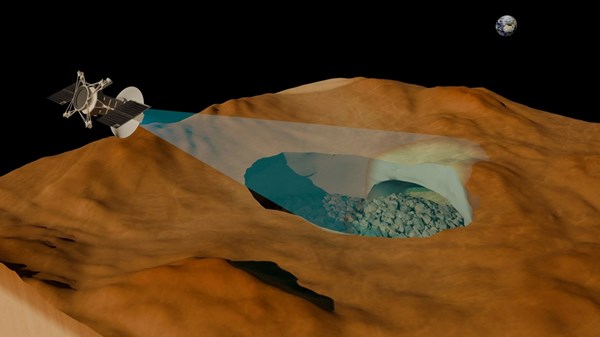
A recent analysis of decades-old radar data from Venus has revealed evidence of a large subsurface cavity caused by volcanic lava flows, marking the first discovery of a subsurface feature on Earth’s neighboring planet. The data, originally collected by NASA’s Magellan spacecraft in the 1990s, provides direct observational confirmation of what scientists had long theorized about Venus lava tubes based on the planet’s extensive volcanic history.
Researchers examining the archival radar information identified characteristics consistent with a geological formation known as a lava tube, similar to those found at volcanic sites on Earth. According to the study published in the journal Nature Communications, this discovery represents a significant advancement from theoretical predictions to actual observation of subsurface structures on Venus.
How Scientists Detected the Venus Lava Tube
The research team analyzed data obtained by Magellan’s synthetic aperture radar between 1990 and 1992, focusing on locations displaying signs of localized surface collapses. These collapse features typically indicate the presence of hollow spaces beneath the surface. The scientists employed newly developed data analysis methods specifically designed to identify subsurface cavities such as lava tubes.
Venus presents unique challenges for planetary exploration due to its thick, toxic cloud cover that obscures the surface. However, radar technology can penetrate these dense atmospheric layers, enabling scientists to study the planet’s geology. This capability proved essential in detecting the subsurface cavity that would otherwise remain invisible to conventional imaging techniques.
Implications for Planetary Geology
Lorenzo Bruzzone, a radar and planetary scientist at the University of Trento in Italy who served as the study’s lead author, emphasized the significance of the findings. According to Bruzzone, the transition from theory to direct observation represents a major step forward and opens doors for new research directions while providing crucial information for future exploration missions.
Lava tubes form when the outer surface of a lava flow cools and solidifies while molten material continues flowing beneath, eventually draining and leaving behind hollow tunnels. Additionally, these geological structures exist on Earth’s moon and are believed to be present on Mars, making the Venus discovery part of a broader understanding of volcanic processes across the solar system.
Future Missions to Study Venus Volcanic Features
Despite being Earth’s closest planetary neighbor, Venus has received considerably less scientific attention compared to Mars in recent decades. However, two major missions are preparing to launch that will dramatically enhance our understanding of the planet’s geology. The European Space Agency’s EnVision mission and NASA’s VERITAS mission will both carry advanced radar systems capable of capturing high-resolution images of the Venusian surface and subsurface.
Meanwhile, EnVision will feature particularly sophisticated orbital radar technology designed to penetrate the surface and explore Venus’s interior to depths of several hundred meters. This enhanced capability should enable scientists to identify additional lava tubes and other subsurface features that remain undetected with current technology. The new radar systems will provide unprecedented detail about the planet’s volcanic structures and geological history.
Understanding Venus Volcanic Activity
The confirmed presence of lava tubes on Venus reinforces evidence of the planet’s significant volcanic past and potentially ongoing volcanic activity. In contrast to Mars, where volcanic activity largely ceased billions of years ago, Venus may still experience periodic eruptions. The discovery of subsurface lava tubes provides researchers with new targets for investigation and potential sites for future robotic exploration.
Both the EnVision and VERITAS missions are expected to launch within the next decade, though specific launch dates have not been finalized. These missions will determine whether additional subsurface cavities exist on Venus and could reveal more about the planet’s volcanic evolution and current geological state.