


Listen to the article
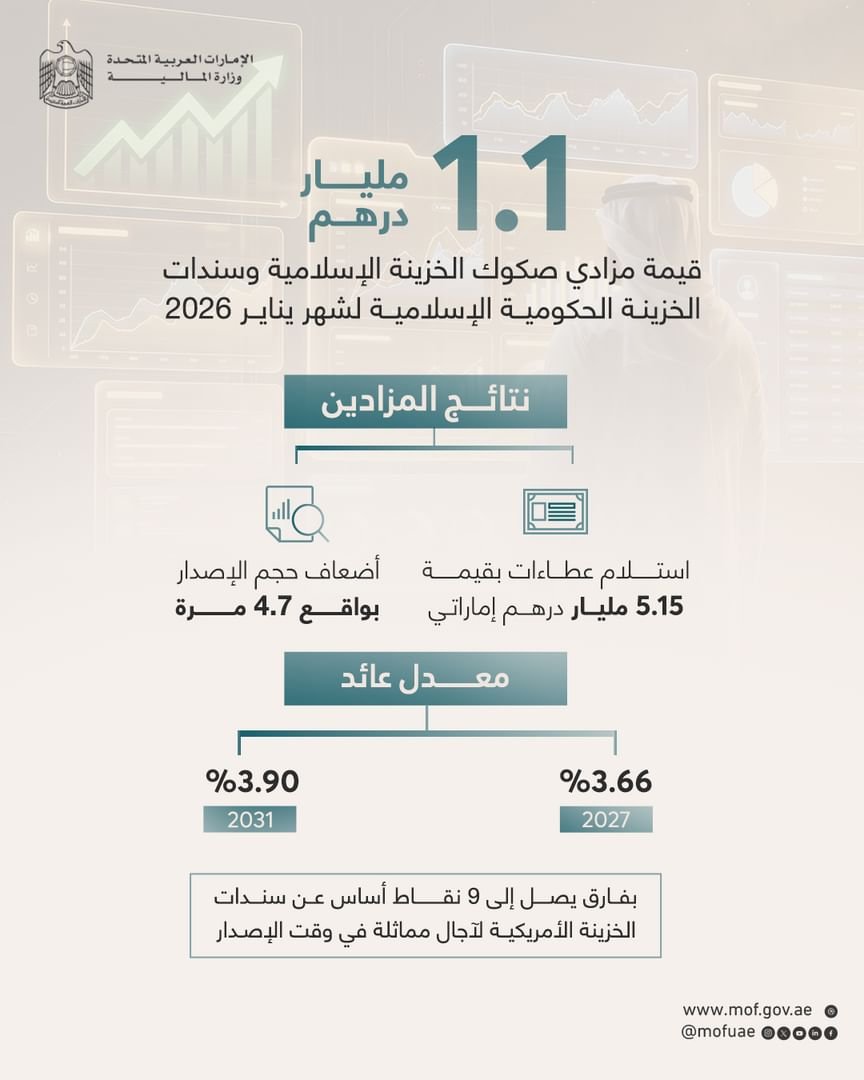
The United Arab Emirates Ministry of Finance has successfully concluded its January 2026 auctions for Islamic treasury sukuk and government treasury bonds, raising a total of 1.1 billion dirhams. The auctions, conducted in collaboration with the Central Bank of the UAE as the issuing and payment agent, represent the first issuances under the 2026 programs for dirham-denominated instruments.
According to the ministry’s announcement on January 31, 2026, these offerings mark a significant milestone as the new treasury bonds represent the first tranche issued under the program since March 2023. The successful auctions demonstrate strong institutional appetite for UAE sovereign debt instruments in the local currency market.
Strong Investor Demand for UAE Treasury Instruments
The dual auctions attracted robust participation from dealing banks for both the sukuk tranche maturing in October 2027 and the newly introduced bond tranche maturing in January 2031. Total bids submitted reached 5.15 billion dirhams, representing approximately 4.7 times the issuance size, according to the ministry’s statement.
This oversubscription ratio reflects investor confidence in the strength of the country’s financial sector and the resilience of the national economy. The competitive bidding environment enabled the ministry to achieve favorable pricing through market-based mechanisms.
Competitive Pricing Achieved in Treasury Auctions
The ministry reported that the sukuk tranche achieved a yield to maturity of 3.66 percent, while the bond tranche recorded a 3.90 percent YTM. These rates were achieved at a narrow spread of just nine basis points over comparable-maturity US Treasury yields at the time of issuance, demonstrating the UAE’s strong credit profile.
Additionally, both the sukuk and bond tranches will be listed on Nasdaq Dubai, enhancing accessibility for investors in the secondary market. This listing supports liquidity and provides transparent price discovery for these government securities.
Building the Dirham Yield Curve
The January issuances contribute to the continued growth of both programs, with the total outstanding balance now reaching 28 billion dirhams across maturities ranging from two to five years. This expansion supports the development of a comprehensive dirham-denominated yield curve, according to ministry officials.
Meanwhile, the dual program structure serves multiple strategic objectives for the UAE’s financial market infrastructure. The programs provide safe investment alternatives for institutional and retail investors while enhancing the competitiveness of the local debt capital market.
However, the significance of reintroducing treasury bond issuances after a three-year hiatus cannot be understated. This resumption deepens the secondary market and provides additional benchmarks for corporate issuers seeking to price dirham-denominated debt.
Strategic Implications for UAE Capital Markets
In contrast to previous years when the UAE government relied primarily on external borrowing, the local currency programs demonstrate a commitment to developing domestic capital markets. The programs support investment environment improvement and contribute to sustainable economic growth, the ministry indicated.
Furthermore, the successful pricing relative to US Treasuries highlights the UAE’s favorable risk assessment by market participants. The narrow spread suggests investors view dirham-denominated sovereign debt as offering attractive risk-adjusted returns compared to global benchmarks.
The ministry has not announced specific details regarding the timing or size of future issuances under the 2026 programs. Market participants will monitor subsequent auction announcements on the ministry’s official website to assess the government’s funding plans for the remainder of the year.