


Listen to the article
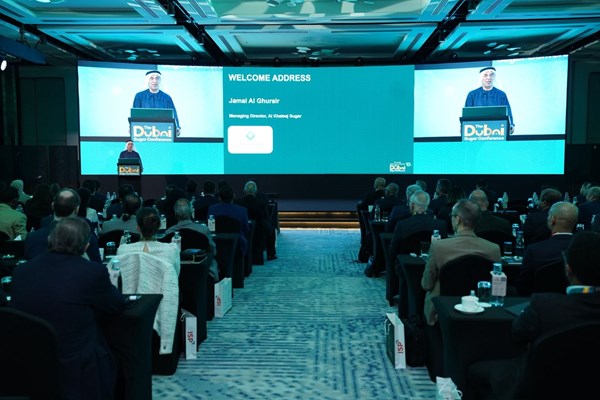
The Dubai Sugar Conference 2026 brought together more than 1,000 delegates from 75 countries to discuss the future of the global sugar industry amid declining surpluses, geopolitical tensions, and climate risks. The conference highlighted how artificial intelligence is transforming the sugar market and examined supply chain challenges facing producers worldwide. The event underscores the UAE’s position as a global hub for commodity trading and logistics between East and West.
Held under the theme “Artificial Intelligence – An Innovative Vision for Shaping Sugar’s Future,” the conference focused on how AI tools are enhancing operational efficiency and sustainability in sugar production. Participants discussed market forecasts predicting a reduced global sugar surplus during the 2026-2027 season due to declining prices, production levels, and inventories.
Global Sugar Market Faces Supply Challenges
According to conference discussions, the global sugar market is experiencing significant shifts as major producing countries including Brazil, India, and Thailand face production constraints. The growing role of sugar refineries in the Middle East and North Africa region has become increasingly important in balancing international trade flows. Industry experts emphasized that climate uncertainties and changing trade policies are adding complexity to supply chain management.
Meanwhile, participants examined how artificial intelligence has become essential for improving forecasting accuracy and supporting sustainable practices in sugar production. The technology is helping companies adapt to climate complications and navigate evolving international trade regulations affecting the industry.
UAE Leads White Sugar Production Through Al Khaleej Sugar
Jamal Al Ghurair, Managing Director and principal shareholder of Al Khaleej Sugar, stated that the UAE continues strengthening its presence in the global sugar market as a leader in white sugar production. According to Al Ghurair, Al Khaleej Sugar, the world’s largest independent sugar refinery, produced approximately 1.5 million tons during 2025 while domestic consumption remains around 250,000 tons annually.
Al Ghurair revealed in press statements on the sidelines of the conference that white sugar prices in the UAE and global markets declined by approximately 20 percent during 2025. He explained that Al Khaleej Sugar currently operates at 60 to 70 percent production capacity according to demand levels, while some production lines function at lower capacity between 30 and 40 percent.
Sugar Industry Navigates Protective Trade Measures
The sugar market locally and globally is experiencing relative stability despite challenges facing the industry, according to Al Ghurair. However, he noted that protective measures implemented by some countries in the region and worldwide contrast with the UAE’s open trade policy, which remains accessible to various countries without restrictions.
Additionally, Al Ghurair indicated that the company handles external protective measures with flexibility appropriate to each market’s nature and imposed customs duties levels. He pointed out that India represents the largest sugar exporter to the UAE without imposing customs fees, facilitating trade flows between the two nations.
Export Expansion and International Presence
Al Ghurair confirmed that Al Khaleej Sugar products currently reach approximately 30 markets worldwide, supported by the strong reputation and high quality of UAE sugar industry. The company looks forward to expanding its export scope during 2026, leveraging its established market presence and product quality standards.
In contrast, regarding foreign investments, Al Ghurair ruled out the company pursuing new investments outside the UAE at present. He clarified that the Al Qanah Sugar project in Egypt, in which the company participates, is proceeding according to the established timeline and has contributed to supplying beet sugar to the Egyptian market for approximately two years.
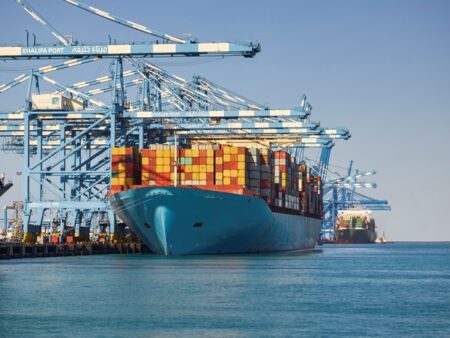
Concerning shipping costs, Al Ghurair explained that the company’s exports have not been significantly affected by freight prices. The company remains more influenced by fluctuations in global sugar prices and protective policies in certain foreign markets, which continue shaping trade dynamics and export strategies.
The conference concluded with industry stakeholders monitoring how market conditions will evolve through the 2026-2027 season, though specific timelines for addressing protective trade measures remain uncertain as producers adapt to changing global dynamics.