

Listen to the article
The short answer is straightforward: Dubai is not located in Iran. On the southeast coast of the Persian Gulf, it is a part of the United Arab Emirates, a confederation of seven emirates. However, the fact that this question continues to come up, particularly during times of regional tension, reveals an intriguing aspect of how people perceive the Middle East.
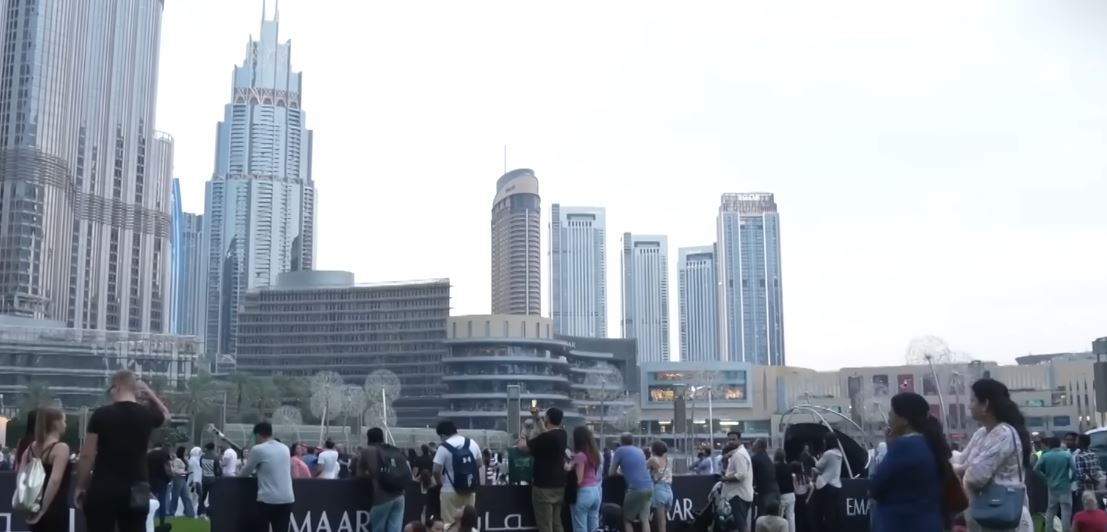
Look west across the water at sunset from a high floor of the Burj Khalifa. The Persian Gulf is a vast expanse of misty blue. Iran is somewhere over that horizon. It’s across a relatively small body of water, not next door as France borders Germany. Even on a clear day, it seems far away.
| Category | Details |
|---|---|
| City | Dubai |
| Country | United Arab Emirates |
| Neighboring Country | Iran |
| Strategic Waterway | Strait of Hormuz |
| Landmark | Burj Khalifa |
| Reference | https://en.wikipedia.org/wiki/Dubai |
Dubai is located geographically on the Gulf’s southeast coast. On the opposite side of it is Iran’s northern coastline. Maritime proximity, not political identity, is what unites them. Maps of the Gulf can make distances appear deceptively small, which is often the source of confusion.
The misunderstanding may have been exacerbated by recent headlines.
The brain has a tendency to compress geography when missiles streak across Gulf skies and news alerts mention Iran and Dubai simultaneously. When Iran hits targets in the Gulf and footage shows Dubai—smoke rising near port cranes, flights diverted—people will naturally wonder if the city is actually a part of Iran. It isn’t.
The UAE shares a land border with Saudi Arabia and Oman. Across the Gulf, it shares maritime borders with Iran. Particularly at this time, that distinction is important.
The UAE and Iran have had a complex but practical relationship in the past. For many years, trade has passed through Dubai’s ports, with Iranian traders conducting business in the emirate’s busy souks and free zones. You can still find Persian eateries in Deira’s older neighborhoods that serve grilled fish and saffron rice, as well as store owners who speak Farsi in addition to Arabic and English.
It’s difficult to ignore how political boundaries can be blurred by interwoven commerce.
However, political sovereignty has always been clear-cut. The Al Maktoum family is in charge of Dubai under the federal system of the United Arab Emirates. It is not under Tehran’s control. The currencies are not the same. The flags are not the same. The governments are autonomous.
So why is the question still there? A portion of it might be caused by the Gulf region’s frequent treatment in international discussions as a single, homogeneous area. Many people outside the region may find it difficult to distinguish between the Gulf states—Dubai, Doha, Riyadh, and Tehran all merging into a single mental image. It’s an oversimplification, but one that makes sense if headlines are the primary source of your publicity.
Being close to the Strait of Hormuz, a tiny channel that a sizable amount of the world’s oil passes through, could be another factor. The UAE is located close to the strait’s southern approach, while Iran occupies one side. The entire region becomes a part of the same strategic narrative when tensions increase there.
It seems as though geography and economics are inextricably linked here, as cargo ships line up close to Jebel Ali and oil prices fluctuate on screens around the world. Even though Dubai is not in Iran, it is close enough that instability in the region spreads swiftly.
Policy has been influenced by this closeness. The UAE has frequently attempted to strike a balance between keeping lines of communication open with Tehran and forming security alliances with its Western allies. When conflict breaks out, the delicate dance becomes more apparent. When missiles or drones pass over the Gulf, the psychological distance significantly decreases.
However, basic facts shouldn’t be obscured by location confusion. Dubai is unquestionably inside the boundaries of the UAE. The most populous city in the nation, it is renowned for its skyline, aviation center, and business-friendly tax climate. Iran is a distinct country with its own history, political structure, and aspirations.
However, the query, “Is Dubai in Iran?” reveals more than just a geographical error. It suggests how intertwined the area feels in times of crisis. Shockwaves travel, but borders stay the same.
When you spend an evening at Dubai Marina, the city seems isolated as you watch yachts sail past neon-lit skyscrapers. Schools are open. Cafés are crowded. Life is humming. The Gulf’s proximity is then brought home to everyone by a regional flare-up.
Whether that intimacy will change perceptions in the long run is still unknown. Investors appear to think Dubai’s reputation as a secure business destination will last. Residents give off an air of assurance. However, the map is always the same. Iran is not home to Dubai. It hasn’t been.
However, it is so close to it that history, trade, and occasionally conflict have combined to create a single regional narrative.