

Listen to the article
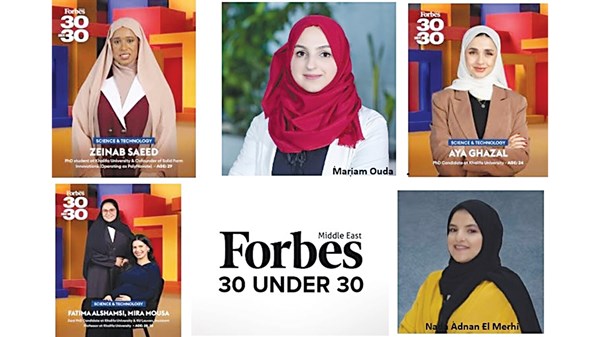
Khalifa University of Science and Technology announced that one faculty member, four doctoral students, and one postdoctoral fellow have been selected for Forbes Middle East’s prestigious “30 Under 30” list for 2025 in the Science and Technology category. The recognition, revealed yesterday according to the official Emirates News Agency (WAM), underscores the institution’s position as a leading force in nurturing talent and driving innovation to address global challenges.
The Forbes 30 Under 30 honorees from Khalifa University include Dr. Mira Moussa, Assistant Professor in the Department of Public Health and Epidemiology at the College of Medicine and Health Sciences, alongside several doctoral researchers making significant contributions across diverse scientific fields. The recognition spans breakthrough work in biomedical sciences, nanotechnology, membrane filtration systems, and advanced materials research.
Groundbreaking Research in Biomedical Sciences and AI
Dr. Mira Moussa and doctoral student Fatima Al Shamsi work within the Biomedical Science Discovery program, where they have made substantial contributions using artificial intelligence tools developed internally at the university. According to the announcement, their research has successfully identified previously unknown genes responsible for endothelial cell dysfunction, potentially opening new pathways for cardiovascular and vascular disease treatment.
The application of AI-driven research methodologies represents a growing trend in biomedical discovery. Their work demonstrates how advanced computational tools can accelerate genetic research and reveal hidden biological mechanisms that traditional methods might overlook.
Innovations in Environmental Solutions and Nanotechnology
Maryam Odeh, a postdoctoral fellow at the Research and Innovation Center for Graphene and Two-Dimensional Materials, designed an electro-membrane filtration system using two-dimensional materials to eliminate nanoplastics from water sources. Additionally, she has filed for a U.S. patent for her innovation, highlighting the commercial potential of her environmental technology.
Meanwhile, Zeinab Saeed, a doctoral student and co-founder of Solid Form Innovations (operating under the name Poly-Novate), established a startup company focused on advanced material solutions. Her entrepreneurial achievements demonstrate how academic research at Khalifa University translates into real-world business applications and technological commercialization.
Advanced Materials and Chemistry Research
Aya Ghazal gained recognition for her participation in developing titanium nitride membranes, which have applications in energy storage, water purification, and other critical industrial processes. However, the specific details of her membrane technology contributions were not disclosed in the announcement.
In contrast, Nada Al Marhi, a doctoral student in chemistry, distinguished herself through innovative research in covalent organic frameworks. These materials represent a cutting-edge area of chemistry with applications ranging from gas storage to catalysis and drug delivery systems.
Khalifa University Commitment to Developing Future Leaders
Professor Ibrahim Al Hajri, President of Khalifa University, stated that the inclusion of a faculty member, four doctoral students, and a postdoctoral fellow on the prestigious Forbes 30 Under 30 list for the Middle East confirms the university’s commitment to empowering the next generation of leaders and innovators. The recognition reflects the institution’s strategic focus on research excellence and talent development.
The Forbes Middle East 30 Under 30 list annually recognizes young achievers who are making significant impacts in their respective fields before reaching the age of 30. Selection for this list involves rigorous evaluation of innovation, leadership potential, and tangible contributions to advancing science and technology.
The university continues to invest in research infrastructure and collaborative programs that support groundbreaking discoveries. These achievements position Khalifa University as a key contributor to the UAE’s knowledge economy and scientific advancement goals outlined in national development strategies.
Further details about specific research publications and commercialization timelines for these innovations are expected to be announced as the projects progress through various development and regulatory stages.