

Listen to the article
The Mohammed bin Rashid Space Centre has solidified the United Arab Emirates’ position on the global space map since its establishment two decades ago, transforming from an ambitious national initiative into a comprehensive system leading space manufacturing projects. According to the centre, this milestone marks twenty years of advancing satellite development, launching artificial satellites, and participating in deep space exploration programs, underpinned by a vision that positioned space as a lever for development, a driver of the knowledge economy, and a platform for building national capabilities.
Over the past twenty years, the centre has successfully built comprehensive capabilities for developing and operating satellites, gradually transitioning from international partnerships to local design and manufacturing. The journey provided practical evidence of the UAE’s ability to enter advanced space industries, contributing to building specialized national expertise in satellite design, assembly, testing, and operation.
Satellite Development Achievements Mark Two Decades
The centre’s trajectory began with DubaiSat-1 and DubaiSat-2, developed in collaboration with international partners, forming the foundation for knowledge transfer and building national expertise. However, the most significant leap came with KhalifaSat, the first satellite designed and developed entirely by Emirati engineers within the UAE, representing a pivotal moment that cemented the concept of localizing space technology.
KhalifaSat’s achievement marked a qualitative shift in the UAE space program’s history, confirming the capability of national cadres to manage complex space projects according to the highest international standards. Additionally, it provided high-precision data supporting urban planning sectors, resource management, and environmental change monitoring, while enhancing the country’s readiness to address various challenges.
Nanosatellite Innovation and Environmental Monitoring
The journey continued with the development and launch of nanosatellites, including Nayif-1, the UAE’s first nanosatellite, and DMSat-1, the first environmental nanosatellite developed in collaboration with Dubai Municipality. Meanwhile, the centre developed HCT-SAT-1, a CubeSat nanosatellite dedicated to Earth observation, executed by Higher Colleges of Technology students under the supervision of centre engineers, representing an applied model linking education with space manufacturing.
Recently, the launch of MBZ-SAT in 2025 represented a major qualitative leap in technical capabilities as the region’s most advanced satellite. According to the centre, it provides Earth observation images with double the precision compared to previous capabilities and ten times more data, expanding the scope of space data applications in supporting planning and decision-making in vital sectors.
Advanced Earth Observation and Radar Technology
The centre also launched Union-SAT, a radar satellite for Earth observation that enables obtaining high-precision images under various weather and environmental conditions. In contrast to optical satellites, this technology enhances the monitoring and tracking system around the clock, regardless of atmospheric interference.
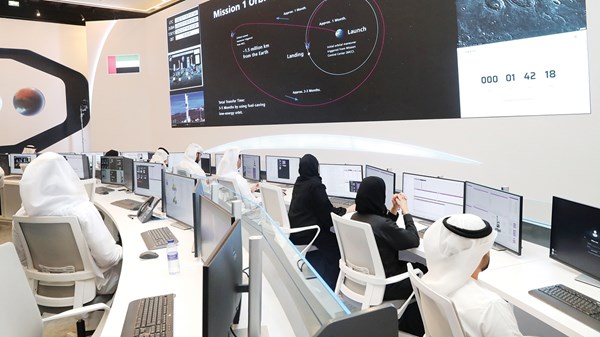
The centre’s ambitions extended beyond these missions, as it continues working on future exploration projects, particularly participation in the Lunar Gateway project. This represents one of the most prominent international initiatives aimed at establishing a space station orbiting the Moon, serving as a platform for future missions to its surface and to Mars.
Lunar Exploration and International Partnerships
In the field of space exploration, the centre opened new horizons for Emirati presence beyond Earth orbit through the Rashid Rover project, the UAE’s first mission to explore the lunar surface. The project carried significant scientific and knowledge dimensions, contributing to building national expertise in space navigation, robotic systems, and operating in harsh environments.
Concurrently with space projects, the centre played a central role in preparing Emirati astronauts and enabling them to participate in manned missions to the International Space Station. This scientific and humanitarian experience contributed to transferring global expertise domestically and enhancing the UAE’s presence in scientific research programs related to space environments, while inspiring new generations to engage in science and technology fields.
Research and Development Ecosystem Supports National Economy
The centre has contributed to building an integrated research and development ecosystem by supporting innovation, developing laboratories, and strengthening partnerships with universities and research institutions inside and outside the country. Furthermore, this effort expanded the space knowledge base and created new opportunities for national companies to participate in space supply chains, supporting economic diversification.
The Mohammed bin Rashid Space Centre continues advancing its strategic projects, with ongoing work on the Lunar Gateway and future exploration missions expected to further establish the UAE’s role as an active partner in shaping the future of space exploration. Authorities have not confirmed specific timelines for upcoming launches, though the centre’s roadmap indicates continued expansion of its satellite constellation and deep space initiatives.