


Listen to the article
Something subtle is changing once more beneath Yellowstone’s towering pines and roaring geysers. Since the middle of 2025, satellite data has shown a subtle but detectable rise in the ground—less than an inch, yet dispersed over a region so large it might completely engulf Chicago. Scientists call it “caldera breathing,” but the metaphor seems less lyrical and more unsettling to anxious onlookers and inquisitive travelers.
Because its deep pools of water, heat, and magma pulse in cycles, Yellowstone is renowned for its rhythms. The ground rises, falls, and then rises once again. However, this most recent inflation is remarkably comparable to past instances that had sparked a rush of headlines and speculative anxieties. However, the current rise is not cause for alarm, according to the US Geological Survey. No anomalous gas emissions, no increase in seismic activity, and no indications of an impending eruption are present. To be honest, that observational clarity is quite comforting.
Highly effective monitoring systems—GPS sensors placed throughout the park, satellite interferometry that can detect even the smallest vertical changes, and thermal imaging instruments that look for irregularities—are the foundation of the science underlying this uplift. These instruments have been incredibly accurate in capturing Yellowstone’s minor variations over time. The park is swelling once more, which may seem concerning, but it’s important to keep in mind that these geological processes happen more often than most people think.
The intricate and multi-layered magma chamber of Yellowstone does not act like a pressure cooker on the verge of blowing up. Rather, it interacts with water and rock systems above it to create a very dynamic but not necessarily hazardous subterranean environment. Scientists think that fluid movement—a mixture of molten rock and superheated water moving upward through permeable rock layers—is what caused the current bulge. Although undoubtedly strong, this process is a component of the park’s inherent thermodynamic cycle.
| Aspect | Detail |
|---|---|
| Location | Yellowstone National Park, Wyoming, USA |
| Feature Type | Supervolcano / Caldera |
| Recent Development | Ground uplift measured at nearly 1 inch since July 2025 |
| Uplift Zone Size | Roughly 19 miles across (comparable to 279 football fields) |
| Primary Cause | Shallow magma accumulation or hydrothermal pressurization |
| Last Major Eruption | Approximately 640,000 years ago |
| Monitoring Agency | Yellowstone Volcano Observatory (USGS) |
| Current Risk Level | Normal – No eruption imminent |
| External Source | USGS Volcano Hazards Program |
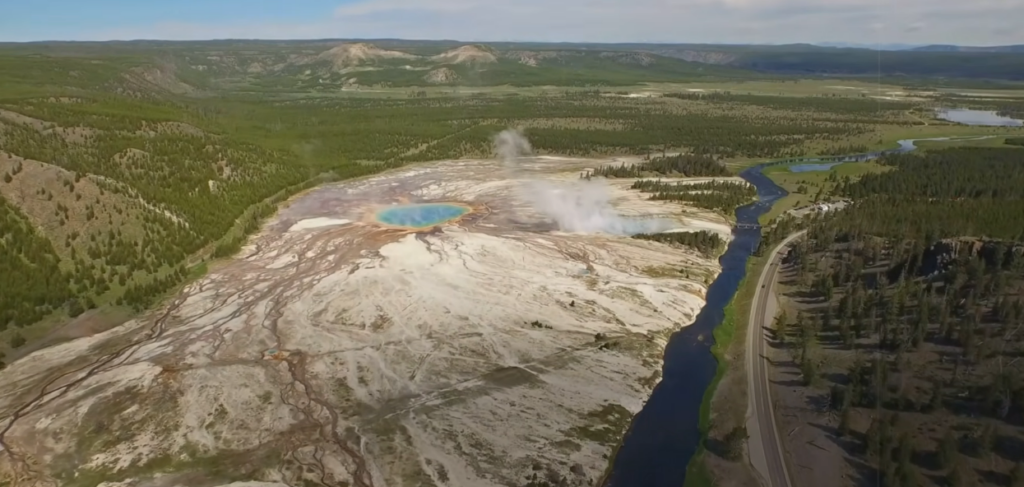
One fall morning, I recall strolling through Hayden Valley while a silent puff of steam rose from a nearby vent and the mist rolled off the Yellowstone River. Everything seemed steady. Even so, I was aware that the earth beneath me had been shifting for centuries—slowly, steadily, and imperceptibly.
It makes sense that the public has taken notice of this most recent bulge, which spans an area the size of an urban sprawl. But context is important. The caldera rose almost 7 inches over six years in the early 2000s, which is a substantial amount more than what we are currently witnessing. And it gradually went away without any problems, just like it does now. Geologic time, not human haste, is what gives Yellowstone its surface life.
Volcanologists have created a very clear picture of Yellowstone’s behavior by combining several data streams. The magma is not rushing to the top. Rather, it is gradually transforming underground, akin to a fluctuating tide beneath a frozen lake. Large caldera systems all throughout the world frequently experience this type of movement, despite its extraordinary scale. When it promotes wider public interest in geological science—without inciting dramatic fear—it becomes especially advantageous.
Significantly, the system is still at the lowest alert level according to the Yellowstone Volcano Observatory. Their updates have been regular, supported by facts, and noticeably composed. the kind of serenity that results from profound knowledge rather than contempt. They are only interpreting concerns based on decades of evidence and real-time monitoring, not dismissing them.
Media sources have rekindled concerns about Yellowstone’s potential for disaster in recent weeks. Furthermore, the science presents a different picture, even though that story works well in disaster fiction. Volcanoes are not “overdue” for eruption. Despite being extensively used, that idea is not supported by science. The calendars of volcanoes are unpredictable.
At Yellowstone, we are witnessing a dialogue between the Earth and its observers rather than a countdown. Over time, that conversation has gotten more accurate, nuanced, and polished. We put ourselves in a position to react wisely in the event that further significant changes ever take place by embracing these signals rigorously and fearlessly.