


Listen to the article
Somewhere in the Gulf, a figure is reading the news in a studio. She wears traditional clothing that has been thoughtfully crafted to evoke cultural warmth, has a human face, coordinated lip movements, and calibrated expressions. She doesn’t require a vacation. She has no opinions. She refuses to engage in contract negotiations. According to the press releases surrounding her launch, she is “tireless” and “ageless”—qualities that more accurately describe software than a saint.
This specific journey started in April 2019 when Abu Dhabi Media and Sogou, a Chinese internet company, agreed to deploy the first Arabic-speaking AI news anchor in history. The UAE Minister of Artificial Intelligence attended the signing ceremony, which took place at ADM’s headquarters. Sogou’s deep learning technology was used by the anchor to synchronize text input with facial expressions and lip movements, creating an almost comfortable uncanny. As stated at the event, the objective was to create a news broadcast that could run continuously in both Arabic and English, 24 hours a day, 365 days a year.
The region’s demand for AI-generated media figures has significantly increased since that 2019 launch. The first-ever AI-powered “Emirati Family” was introduced by Digital Dubai in July 2025. These virtual characters, dressed traditionally, are intended to convey government messages about digital services in a “relatable, engaging, and accessible format.”
A young girl dressed traditionally with “a modern twist” was the first member to be introduced, according to the announcement. The public was asked to select one of three names for her: Latifa, Dubai, or Mira. Soon, a mother, father, and brother would be added to the family.
| Topic | Details |
|---|---|
| Milestone | UAE’s first Arabic-speaking AI news anchor debuted in 2019 via Abu Dhabi Media (ADM) and Chinese tech firm Sogou Inc. — first Arabic-speaking AI anchor in the world |
| Technology | Speech synthesis, deep learning, image detection; text input converted to synchronized lip movements and facial expressions |
| Digital Dubai AI Initiative (2025) | AI-powered “Emirati Family” — virtual characters in traditional attire delivering government digital service messages; public asked to name the first character (options: Dubai, Mira, or Latifa) |
| Kuwait’s AI Anchor (2023) | “Fedha” — blonde, light-eyed avatar representing Kuwait’s diverse population; debuted with 13-second video that generated mass social media reactions |
| India’s AI Anchor (2023) | “Sana” — launched by India Today/Aaj Tak; described at launch as “bright, gorgeous, ageless, tireless”; presented news multiple times daily |
| China’s First AI Anchor | Xinhua News Agency — world’s first AI male anchor launched 2018; first AI female anchor followed in 2023 |
| NewsGPT (2023) | First news channel with entirely AI-generated content — launched March 2023; CEO called it “a game changer” |
| The Core Concern | Ageless, unpaid, always available anchors create structural pressure on human broadcasters; risk of bias embedded in training data; no editorial judgment or accountability |
The Gulf is not the only place where this kind of thing occurs. In order to “represent everyone” in Kuwait’s diverse population of citizens and expatriates, Kuwait News introduced “Fedha,” a virtual anchor with blonde hair and light eyes, in April 2023. Regardless of its content, the deputy editor described the 13-second debut video as generating “a flood of reactions”—a level of engagement that most actual journalists would envy. In the same year, “Sana” made her debut on India’s Aaj Tak channel; Prime Minister Modi was present when the vice chair of India Today called her “bright, gorgeous, ageless, tireless.” Since 2018, China’s Xinhua News Agency has had an AI anchor; in 2023, a female version replaced the male one. In the same year, Zae-In was introduced by a Korean network. Every piece of content on the channel NewsGPT is now produced by artificial intelligence.
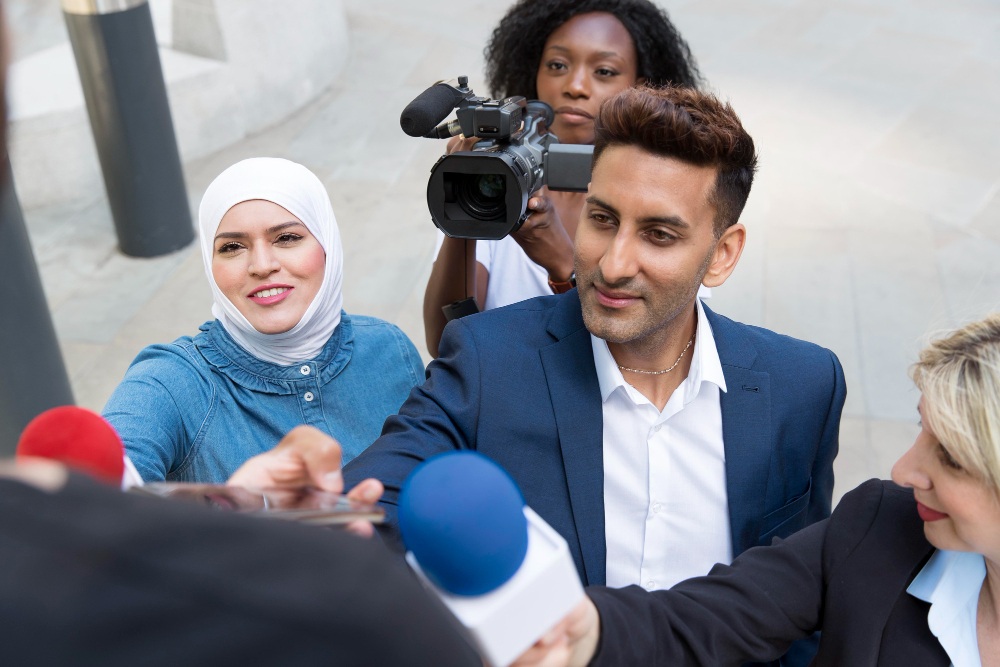
There is a pattern to the response to these launches. initial interest. The eerie-valley appearance of a face that is almost human but clearly processed has caused some viral fascination. Journalists and media critics comment on the ramifications. Then, over time, familiarity—the process by which once-astonishing technologies fade into background presumptions.
The issues that are brought up are valid and frequently revolve around the same few problems. Data is used to train AI anchors, and data contains the prejudices of its creators and curators. A human journalist covering a story in Riyadh or Mumbai contributes contextual judgment, which is the capacity to recognize when a government press release leaves out crucial information, when a source appears uneasy, or when the official explanation doesn’t make sense. That is not present in an AI anchor reading a bulletin. It has facial expression calibration and a script. Perhaps your perception of the anchor’s true purpose will determine whether or not that distinction matters. AI can reliably and affordably deliver pre-written news copy if the anchor’s job is to do so. The replacement is different if the anchor’s role is to represent the editorial weight of journalism, which is the impression that a real person with accountability is presenting facts they support.
Additionally, the “ageless, tireless” framing deftly avoids the labor question. In reality, news anchors are paid, employed, and subject to unionization. They have opinions, mortgages, and sporadic salary disputes. None of those limitations apply to AI anchors. With the exception of the initial build cost, which tends to decrease as the technology advances, deploying one is less expensive overall. The structural pressure this puts on broadcast journalists is real, as evidenced by how frequently proponents of the technology characterize its benefits in terms that are exactly the benefits of not needing to hire a human.
The viewers’ disagreement over Dubai’s AI anchor stems from a genuine issue. Aesthetics play a role in this division; while some find AI-generated faces intriguing, others find them unsettling in ways they can’t quite put their finger on. However, a more significant aspect of it is a dispute over the purpose of news and who is in charge of it. A journalist seeking accountability is not the same as a government-affiliated AI family delivering authorized messages about digital services. The technology is comparable. It’s not the goal. It’s difficult to ignore the fact that those who stand to gain from lowering the expense and independence of journalism are the ones who are most enthusiastic about AI news anchors.
The anchors will continue to show up. The family will continue to expand. It will eventually become more difficult to summarize in a press release what they stand for and what they have replaced.