



Listen to the article
On the outskirts of the North Carolina State campus is a small, largely unremarkable building where, on most days, a machine is conducting an experiment that no human has ordered. It pulls a tiny stream of chemicals through a glass channel that is thinner than a coffee stirrer, observes the reaction in real time, and determines what to try next on its own. The lights are humming. A cooling fan rotates. A graduate student is checking their email somewhere down the hall. Whether they are present or not, the science is taking place.
Milad Abolhasani owns the lab, and his team’s work, which was published in Nature Chemical Engineering last July, sounds modest until you read it twice. Compared to the older steady-state setups that everyone else has been using, their self-driving system, which is based on what chemists refer to as dynamic flow, collects at least ten times more data per experiment. The device gathers a new data point every 30 seconds rather than waiting an hour for one sample to complete. A picture turns into a film. After watching the film, the algorithm gains knowledge.
| Quick Facts: AI-Driven Materials Discovery | Details |
|---|---|
| Lead researcher (NC State) | Milad Abolhasani, ALCOA Professor, Chemical and Biomolecular Engineering |
| Institution | North Carolina State University, Raleigh |
| System type | Self-driving laboratory with dynamic flow chemistry |
| Speed advantage reported | At least 10× more experimental data versus traditional steady-state flow |
| Data capture rate | One reading every 0.5 seconds during reactions |
| Key publication | Nature Chemical Engineering, July 14, 2025 |
| Funding | U.S. National Science Foundation; UNC Research Opportunities Initiative |
| MIT counterpart platform | CRESt (Copilot for Real-world Experimental Scientists) |
| MIT lead | Ju Li, Carl Richard Soderberg Professor of Power Engineering (MIT News) |
| CRESt scope | Explored 900+ chemistries; ran 3,500 electrochemical tests |
| CRESt headline result | Catalyst with 9.3× better power density per dollar than pure palladium |
| Google DeepMind tool | GNoME — predicted 2.2 million new inorganic crystals; 380,000 deemed stable |
| Microsoft + PNNL battery project | Reduced lithium use by ~70% in a new electrolyte material |
| Typical historical timeline | 20+ years from material discovery to commercial product |
This distinction is more important than it might seem. Self-driving labs have been around for a few years; they are essentially robots that have been combined with machine-learning brains to search through chemical possibilities in a manner similar to how a chess engine searches through positions. It has always been promised that materials discovery, which has historically been a laborious process involving trial and error and the weariness of PhD students, could be reduced from decades to months. It appears that Abolhasani’s team used fewer chemicals to compress the months into something like days. Reading the paper gives me the impression that the bottleneck has finally shifted.
It is difficult to ignore how rapidly this area of science has grown congested. Nearly 380,000 of the 2.2 million new inorganic crystals predicted by Google DeepMind’s GNoME tool in late 2023 were deemed stable enough to warrant further investigation. This is more than all of the crystals that human chemists had cataloged in the preceding century or so put together. AI was used by Microsoft and Pacific Northwest National Laboratory researchers to sort through over 32 million potential battery electrolytes and identify one that required roughly 70% less lithium. That project took nine months from concept to working prototype.
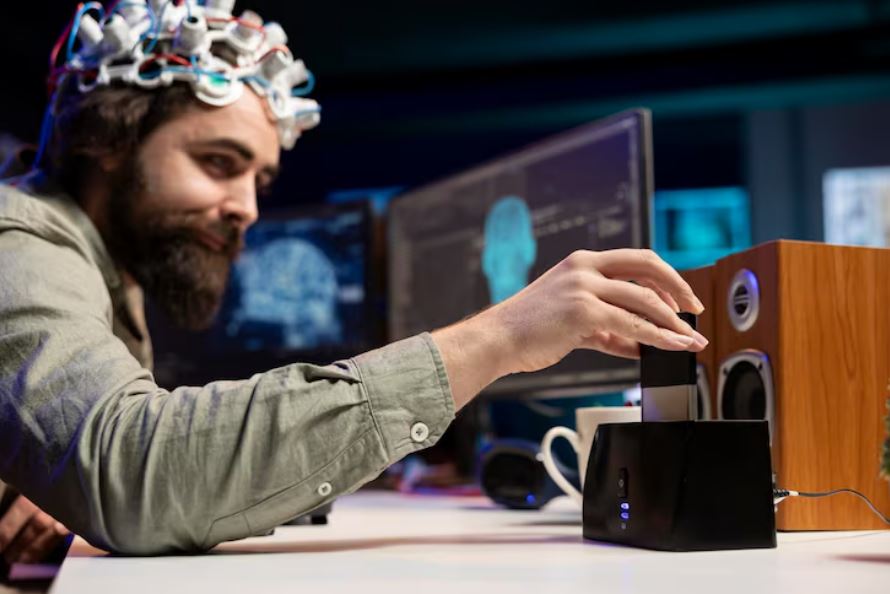
Naturally, MIT is also involved in the discussion. In late September, Ju Li’s team unveiled a platform called CRESt, which stands for Copilot for Real-world Experimental Scientists. This awkward name refers to a chatty research assistant that is wired to a swarm of robots. You express your desires to it in simple terms. After reading the literature, it plans an experiment, conducts it, examines the electron microscopy images that are produced, and considers its next course of action. In order to identify a fuel-cell catalyst that outperforms pure palladium by more than nine times per dollar, CRESt screened over 900 chemistries. If that number holds true outside of the demo, it has the potential to subtly transform entire industries.
Of course, skepticism is necessary. Materials that appear fantastic on paper but behave poorly in a beaker can be created by generative models. It is unlikely that the majority of DeepMind’s 380,000 stable crystals will ever be produced, much less put to use. The older, more difficult-to-quantify issue is what is lost when scientists stop exploring—when the unbridled curiosity that led to the creation of rubber, Teflon, and cement is squeezed out by an algorithm that optimizes for whatever box was checked at the beginning. According to James Warren of NIST, it frequently takes more than 20 years between the discovery of a material and its incorporation into a phone. It is one thing to use software to close that gap. Another is figuring out what to close it toward.
Nevertheless, there’s a sense that something enduring is changing as this plays out. Not the cacophonous shift on the marketing deck. The more subdued kind, where a chemist in Cambridge speaks to her instruments in English and a lab in Raleigh operates all night without anyone present, where the question is no longer whether the machines can keep up but rather whether the rest of us can.