




Listen to the article
The sheer improbability of what the UAE has accomplished begins to feel almost surreal at a certain point, somewhere between the scientific papers and the raw data downloads. Some of the most important atmospheric data ever gathered from Mars is currently being produced by Dubai, a city most people associate with record-breaking skyscrapers and opulent hotels. And researchers are genuinely uneasy about some of what that data is revealing.
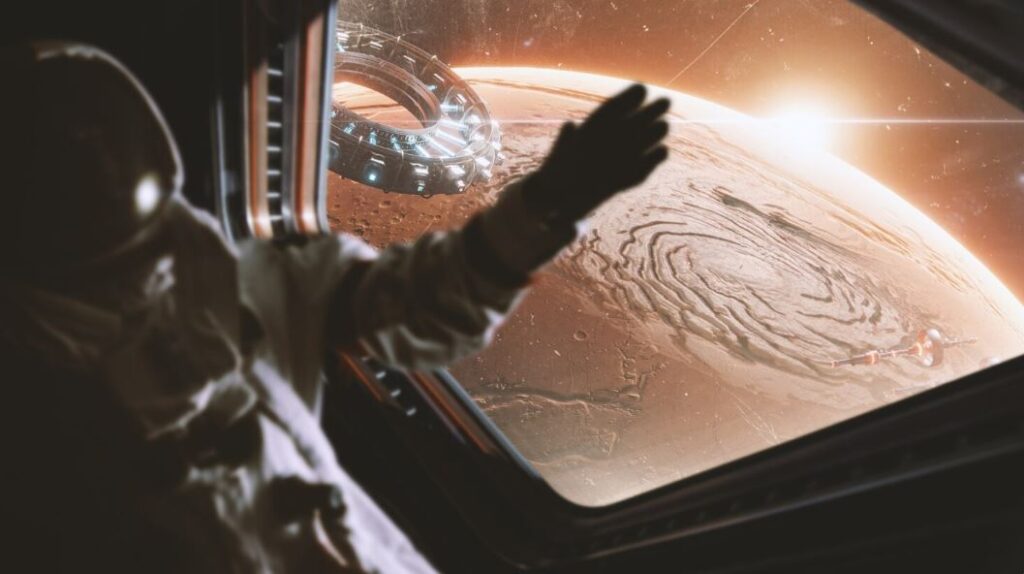
Launched in the summer of 2020 and reaching Mars in February of 2021, the Hope Probe has been silently circling the Red Planet in a broad elliptical orbit, gathering data in a manner never seen before. It is comparable to only ever seeing a city at 2 a.m. or 2 p.m. and calling it understood. Previous Mars orbiters usually captured the planet’s atmosphere at roughly two fixed moments in the local day. That is not how hope operates. It cycles through the conditions of a full Martian year, covering all local times on the planet. Scientists working on the mission say there is a significant difference in what that reveals.
| Category | Details |
|---|---|
| Mission Name | Emirates Mars Mission (EMM) — Hope Probe (Al Amal) |
| Launched By | Mohammed bin Rashid Space Centre (MBRSC), Dubai, UAE |
| Launch Date | July 20, 2020, from Tanegashima Space Center, Japan |
| Mars Arrival | February 9, 2021 |
| Mission Duration | Extended to 2028 (announced February 2026) |
| Spacecraft Weight | ~1,350 kg (roughly the size of a small car) |
| Orbital Range | 20,000 km – 43,000 km from Mars surface |
| Orbital Period | One complete orbit every 55 hours |
| Science Instruments | EXI (camera), EMIRS (infrared spectrometer), EMUS (ultraviolet spectrometer) |
| Data Released | Over 76 GB per batch; freely available globally |
| Knowledge Partners | University of Colorado Boulder, Arizona State University, UC Berkeley |
| Primary Goal | Full-year, all-hours atmospheric mapping of Mars |
The atmospheric turbulence is what has drawn the greatest attention. Variations in atomic oxygen density that were significantly higher than predicted by current models were identified in early data batches. Additionally, the upper atmosphere’s ultraviolet light distribution did not match predictions. Decades of earlier modeling may have been based on an incomplete picture, not necessarily incorrect, but incomplete in ways that weren’t apparent until you had continuous, worldwide coverage. Researchers feel that the Hope Probe is compelling a sort of recalibration, not a revolution, but something more unsettling: the recognition that certain assumptions were based on scant information.
Unexpected discoveries regarding the small moon Deimos of Mars have also been made by the mission. Its composition appears to be different from what one would anticipate from a captured asteroid, which contradicts the long-held theory regarding its origin. Rather, the evidence suggests a planetary origin, suggesting that Deimos may have split off from Mars at some point in deep time. That is the kind of discovery that sparks debate at conferences. The fact that a UAE atmospheric mission produced it almost as a side observation says something about the extent of what Hope is doing up there, though it’s still unclear if it will hold up under further scrutiny.
The data releases have been made public on purpose. In the second batch alone, more than 76 gigabytes of raw observations were made publicly available for anyone interested to download and examine. Approximately two terabytes of data were retrieved by researchers, educators, and space enthusiasts worldwide in the first ten days following the initial release. The Emirates Mars Mission team made a fundamental decision to treat science as a shared resource rather than a competitive one, which is why that kind of engagement wasn’t accidental. As that develops, it’s difficult to ignore how the UAE is positioned differently from the more cautious stances of some larger space programs.
The mission was extended through 2028 in February 2026, allowing scientists more time to watch how the Martian atmosphere changes over several seasonal cycles. Because Mars’s atmosphere is dynamic—it expands and contracts as the planet travels through its orbit, and dust storms can significantly change conditions—long-term monitoring is crucial. The deeper patterns typically show up when those changes are documented over years as opposed to months. One of the most eager questions for the mission is what those patterns will ultimately reveal about atmospheric escape, the process by which Mars has been steadily losing its air to space over billions of years.
It’s important to keep in mind that the UAE lacked a planetary science department six years prior to launch. Working with university partners in Colorado, Arizona, and California, the engineers and scientists who built Hope received most of their training from the mission itself. Learning by doing something truly challenging is an uncommon approach to developing a space program, but the outcomes seem to indicate that it was successful. The data from Dubai’s Mars mission is now permanently included in the scientific record of what we know about other planets. Regardless of what happens next, that is a big deal.