




Listen to the article
Safe Dubai 2026 brought together senior infrastructure leaders, regulators, consultants, and technology specialists from across the Middle East to advance the region’s move towards a more structured and joined-up approach to infrastructure intelligence.
The second edition of the forum built on the groundwork laid in 2025, which centred on integration and awareness. In 2026, discussions moved towards decision intelligence at asset and city scale, reflecting the growing complexity of infrastructure development across the Middle East.
As governments across the region continue to invest in metro systems, tunnels, high-speed rail, airports, ports, and large-scale urban development, the need for cross-domain intelligence has grown. Safe Dubai 2026 examined why the Middle East needs to bring together instrumentation, surveying, geospatial systems, and remote sensing within shared frameworks that support engineering judgement and long-term resilience.
A keynote address by Kenichi Soga, Professor at the University of California, Berkeley, was a focal point of the event. Drawing on global infrastructure case studies, Professor Soga examined what decision intelligence means in practice, beyond dashboards and data integration. He stressed the importance of continuous monitoring, long-term data archives, and disciplined interpretation. He also noted that machine learning and artificial intelligence can only produce meaningful results when built on sound instrumentation and coherent data foundations.
The technical keynote traced the shift from fragmented monitoring technologies and isolated reporting towards a multi-layered intelligence framework. Delegates looked at how macro-scale remote sensing, geospatial intelligence, IoT-enabled sensor networks, and precision instrumentation can work together to support confident decision-making. The Infinitus 2.0 platform was presented as an example of how integrated data can feed structured decisions rather than simply produce visual outputs.
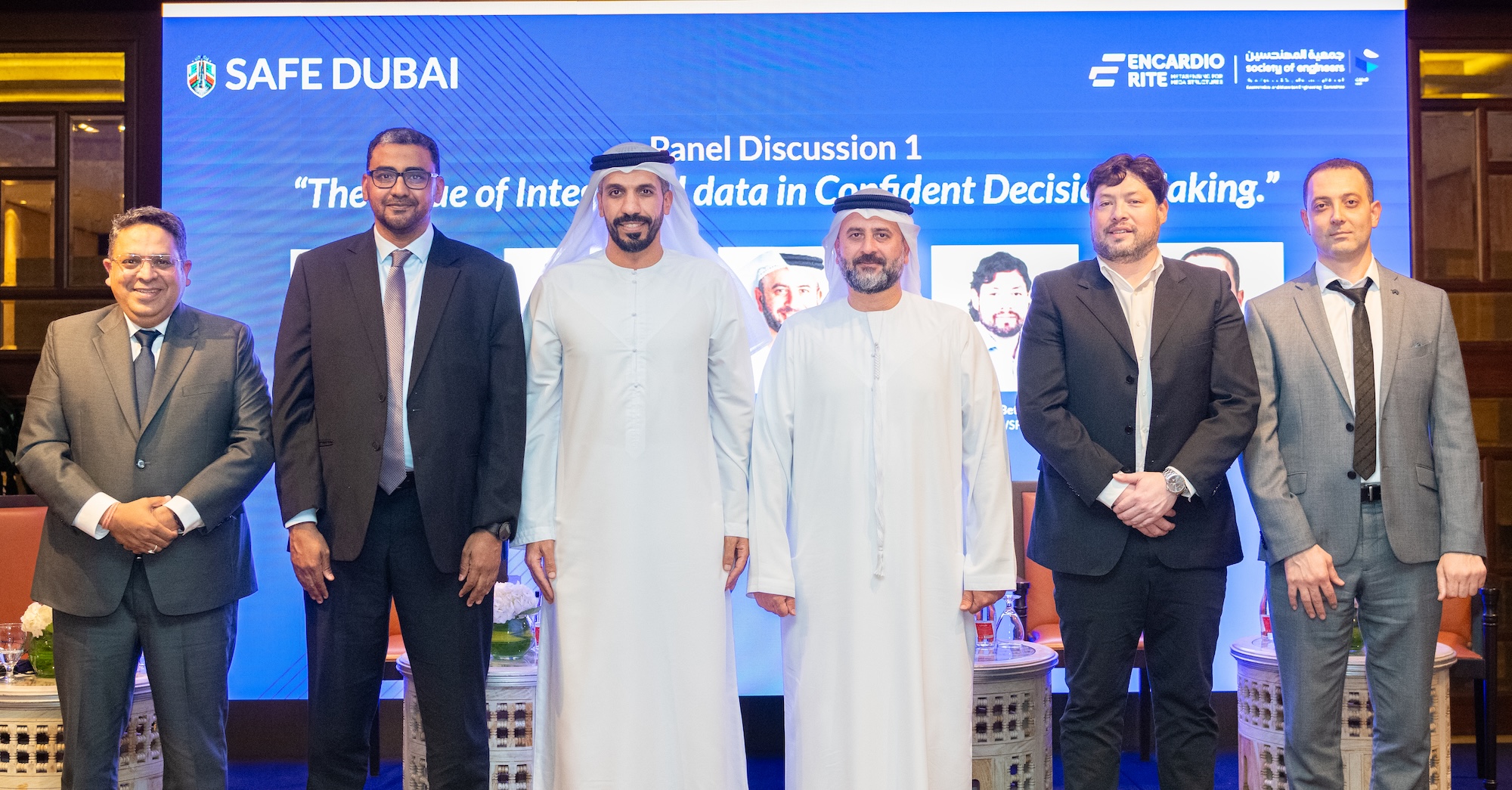
Panel discussions throughout the day treated integration as a foundation rather than a final goal. Regulators, consultants, and asset owners discussed governance, ownership models, standards, and inter-agency workflows needed to build region-wide monitoring ecosystems. Participants pointed to the measurable benefits of unified datasets, including reduced risk, better operational efficiency, and more predictable maintenance planning.
The afternoon sessions looked at what follows integration. Participants explored how the Middle East could move from project-based monitoring towards system-level intelligence, enabling better prioritisation, resource allocation, and long-term infrastructure management over the next decade.
Arushi Bhalla, Managing Director of Encardio Rite Group of Companies, said: “Safe Dubai 2026 reflected the Middle East’s readiness to move beyond fragmented monitoring practices. The region is building infrastructure at an extraordinary scale, and that scale demands coordinated intelligence frameworks. Integration created awareness. The next step is embedding decision intelligence across assets and agencies so that infrastructure performance is managed proactively, not reactively.”
Safe Dubai 2026 closed with a shared view that the Middle East is well placed to lead the next phase of engineering progress by establishing unified monitoring frameworks and building infrastructure intelligence at scale.