




Listen to the article
Key Takeaways
🌐 Translate Article
📖 Read Along
💬 AI Assistant
The surface of Venus has always felt a little mysterious, almost stubbornly so. Thick yellow clouds wrap the planet like a permanent curtain, reflecting sunlight so brightly that early astronomers once imagined oceans hiding underneath. Of course, we now know the truth is far less welcoming. Temperatures there can melt lead. The atmospheric pressure would crush most spacecraft within minutes.
Still, the planet keeps surprising scientists. Recently, researchers studying decades-old radar images discovered something strange beneath the Venusian surface — what appears to be a massive underground tunnel carved by ancient lava flows. The structure is enormous by planetary standards. Early estimates suggest the hollow channel could reach nearly a kilometer across, large enough to swallow entire city blocks on Earth. That alone has left many experts quietly astonished.
| Field | Information |
|---|---|
| Discovery | Possible massive underground lava tube beneath Venus |
| Location | Near Nyx Mons volcanic region |
| Estimated Size | Up to ~1 kilometer wide, at least 375 meters deep |
| Detection Method | Reanalysis of radar data |
| Original Mission | NASA’s Magellan spacecraft (1990–1992) |
| Lead Research Institution | University of Trento, Italy |
| Lead Scientist | Lorenzo Bruzzone |
| Study Published In | Nature Communications (2026) |
| Future Missions Linked | NASA VERITAS & ESA EnVision |
| Reference Source | https://science.nasa.gov |
The discovery didn’t come from a brand-new spacecraft or a dramatic mission announcement. Instead, it emerged from a careful re-examination of radar data gathered in the early 1990s by NASA’s Magellan probe. The spacecraft spent several years orbiting Venus, mapping the planet with radar signals capable of piercing through the thick cloud cover.
Those maps, it turns out, still have secrets. Researchers from the University of Trento in Italy began reanalyzing Magellan images using newer image-processing techniques. While scanning the rugged volcanic region known as Nyx Mons — a vast shield volcano named after the Greek goddess of night — they noticed something unusual: a deep depression in the ground that looked like a collapsed roof.
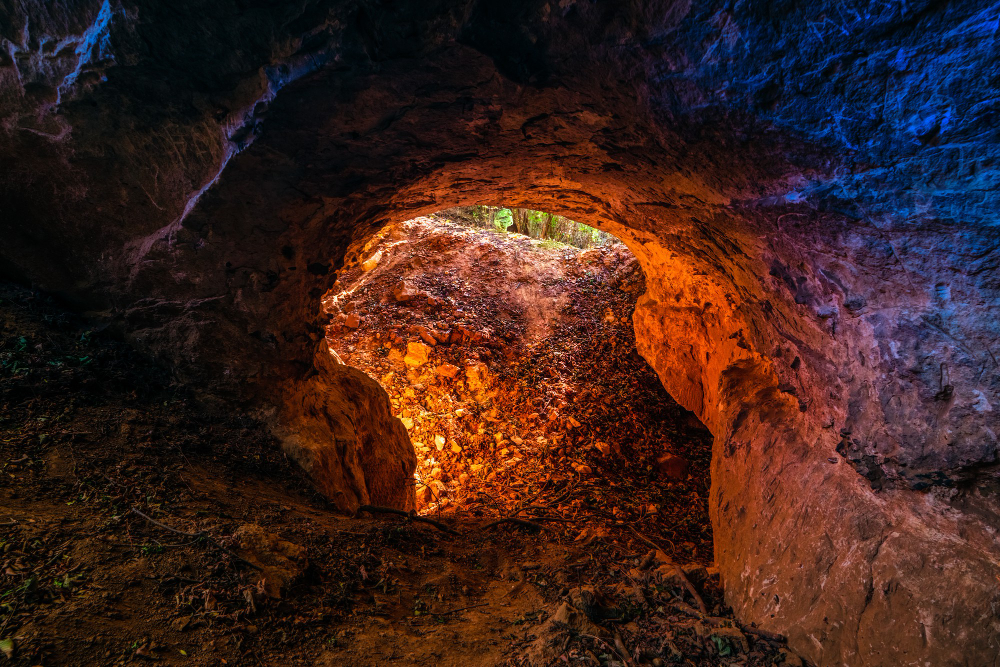
Planetary geologists call these features “skylights.” On Earth, skylights often appear when the roof of a lava tube collapses, revealing an underground tunnel where molten rock once flowed. The same kinds of tubes exist on the Moon and Mars. But on Venus, they had remained mostly theoretical.
Looking closer at the radar signals, scientists estimated that the pit plunges roughly 150 meters down before opening into a much deeper empty space. Beneath the surface lies a cavern stretching at least 375 meters downward. And based on surrounding terrain, the tunnel may extend for dozens of kilometers underground.
It’s possible that this is only the visible tip of a far larger system. Standing back from the data, there’s a moment where the scale becomes hard to grasp. Lava tubes on Earth are impressive but usually modest in size — perhaps tens of meters wide. On the Moon, where gravity is weaker, they can grow larger. But a kilometer-wide tunnel? That begins to feel almost surreal.
Yet Venus might be the perfect place for such structures. The planet’s thick atmosphere and slightly lower gravity could allow lava flows to form stronger insulating crusts while molten rock continues moving beneath the surface. Over time, that flowing lava can carve out enormous channels, leaving behind hollow tunnels once the eruptions stop.
Watching scientists piece together this puzzle, there’s a quiet reminder that Venus is far more active than its clouded appearance suggests.
For years, the planet was sometimes described as geologically “dead.” That idea has slowly been fading. Evidence now hints that volcanic activity may still occur there today. Some spacecraft observations have even spotted surface changes that look suspiciously like fresh lava flows.
If that’s true, the massive tunnel beneath Nyx Mons might not be just an ancient relic. It could be part of a still-evolving volcanic landscape.
There’s also another curious possibility. On the Moon and Mars, lava tubes have attracted attention for a very different reason: they might serve as natural shelters for astronauts. Their thick rock ceilings could protect explorers from radiation and meteorites.
Venus, unfortunately, is a different story. Any human mission to the surface would face crushing pressure and temperatures above 460°C. Electronics struggle to survive even a few hours. So while the idea of exploring these underground caves is fascinating, it remains firmly in the realm of distant speculation.
Still, the discovery matters for another reason. Understanding how lava tubes form helps scientists reconstruct the volcanic history of a planet. Venus is often called Earth’s “twin” because the two planets are nearly the same size. Yet their destinies diverged dramatically. Earth became habitable. Venus turned into an inferno.
Figuring out why remains one of planetary science’s most stubborn questions. The newly detected tunnel offers another piece of that puzzle. Its size suggests enormous lava flows once moved across the Venusian surface, shaping landscapes in ways that may differ from Earth’s tectonic processes.
And there’s reason to think this discovery is just the beginning. New spacecraft are already on the way. NASA’s VERITAS mission and the European Space Agency’s EnVision probe are both expected to arrive in the early 2030s, carrying far more advanced radar systems. These instruments should be able to see the Venusian surface — and possibly the subsurface — in unprecedented detail.
When those missions begin sending data back to Earth, scientists may find more collapsed skylights, more tunnels, perhaps even entire networks hidden beneath the planet’s crust.
Watching this story unfold, there’s a sense that Venus is slowly revealing itself, almost reluctantly. For decades it remained one of the solar system’s most frustrating planets to study. Too hot, too cloudy, too hostile.
Yet with each new discovery — a volcano here, a lava tunnel there — the planet feels a little less distant.
And somewhere beneath those swirling clouds, deep inside the crust near Nyx Mons, a cavern the size of a skyscraper still waits in complete darkness, carved by lava long before humans ever pointed a telescope toward the sky.