

Listen to the article
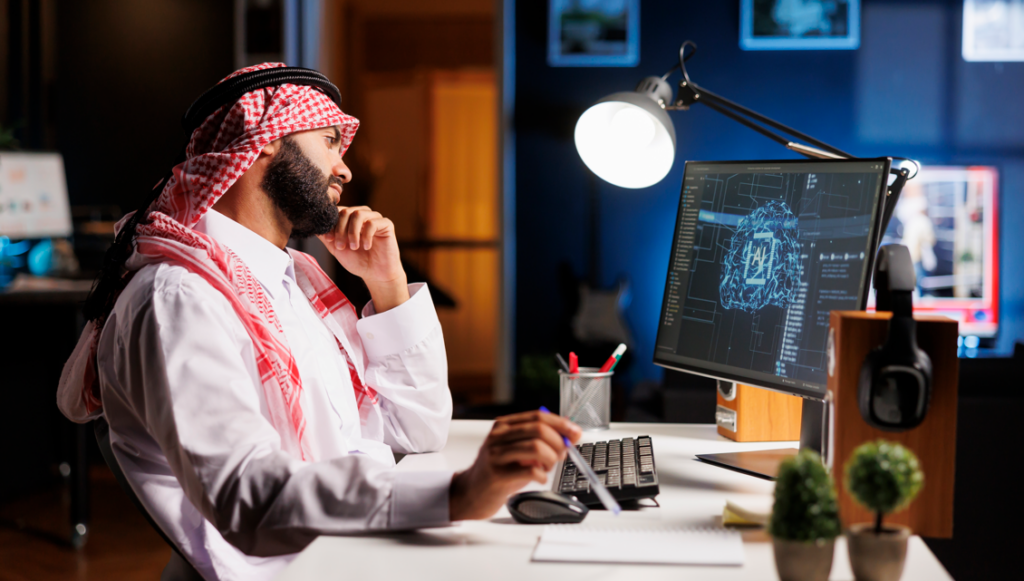
Half confession, half dare, the pitch sounds like something heard in a hotel lobby at two in the morning. A startup claims it can use artificial intelligence (AI) to decode your dreams in Dubai, a city where glass towers glow long after midnight and founders treat sleep like a bug that needs to be fixed. not interpret them in the traditional, comfortable Freudian manner. Transform the chaos of a night’s REM into something printable by decoding them in the same manner that you decode audio or translate text.
Dubai’s taste for bold concepts is reflected in the scene. A demonstration table. A stylish headband. A sleep graph on a phone screen that appears comfortingly clinical. People are leaning in and nodding as if they don’t care. It’s always assumed that anything that can be measured can be made better, and that anything that can be made better can be sold.
| Category | Details |
|---|---|
| Location | Dubai, UAE (startup demos, investors, accelerators, and a growing “AI-first” policy vibe) |
| Claimed product | “Dream decoding” via sleep headgear + AI models, turning REM-stage signals into words, themes, or “meaning” |
| Related precedent | REMspace claims “dream-to-dream communication” using lucid dreamers, timing cues during REM sleep, and sensors; experts say it’s unverified and not backed by current neuroscience |
| What’s measurable today | Sleep stages (REM vs non-REM), some sensory processing during sleep, broad patterns of brain activity—not a clean transcript of dream content |
| Key skepticism | “Transmitting” or decoding specific words from dreams remains unclear; high cost/complexity; limited peer-reviewed validation |
| Authentic reference | The National’s reporting and expert commentary from NYU Abu Dhabi researchers on why these claims aren’t yet substantiated |
However, the phrase “dream decoding” is loaded because it suggests that the dream itself is there, undamaged, and just waiting to be retrieved. That isn’t actually how neuroscience functions today. Researchers are able to track patterns, identify stages of sleep, and occasionally deduce general categories of mental activity.
However, bringing up a particular story—your flooded childhood home, the face of that stranger, the teeth-falling cliché—remains more rumor than fact. According to experts cited in UAE reporting, even the more sensational experiments—such as REMspace’s claims about lucid dreamers exchanging words while they sleep—have not yet been independently confirmed in peer-reviewed studies.
REMspace is helpful in this case because it illustrates what the most ambitious version of this story looks like, not because it provides any proof. In what the company refers to as “dream-to-dream communication,” one sleeper uses headphones to hear a random word while in REM sleep, “speaks” it inside the dream, and another dreamer later recognizes the same word.
It’s an exciting concept that gains traction more quickly than a software update. It’s also the kind of claim that prompts scientists to issue warnings: intriguing, perhaps, but unproven, and it’s still unclear how information would actually be transferred from brain to brain as opposed to being explained by more straightforward effects.
In this ecosystem, Dubai’s dream-decoding startup doesn’t have to make telepathic promises. It can attract attention by promising something more nebulous, such as “themes,” “emotional signatures,” or “hidden beliefs.” The language becomes ambiguous at that point.
Correlations between sensor data and self-reported experiences can undoubtedly be learned by a model. The system can begin to predict when you will label dreams as “anxiety” again if you wake up and do so. Maybe useful. That isn’t deciphering the dream, though. Predicting your labels is what that is.
Furthermore, hardware is more important than most pitches acknowledge. General brainwave activity can be detected by EEG headgear, which aids in identifying sleep stages, such as REM, which is frequently associated with vivid dreams. However, far richer signals and very careful experimental design would be needed to decode specific dream content. The complexity was emphasized by experts cited in The National: tracking several physiological indicators, accurately determining sleep stage, and then attempting any sort of decoding—work that is expensive and time-consuming and not the type of thing that usually gets polished into a consumer app on a neat timeline.
It’s difficult to ignore why founders are interested in this, though. Dreams are a personal realm. They could be a dataset as well. It’s reasonable to think that sleep will be the next big thing, especially in a world where wellness spending is steadily increasing and “self-optimization” has become a status symbol. After all, phones have made location into money, and social apps have made attention into money.
The claim lands for a more subdued reason: people want their dreams to have significance. Not necessarily in a mystical way. in a useful manner. Even though it’s just correlation, it might feel like insight if an AI could tell you that your nightmares stop when you stop scrolling in bed or that your recurrent airport dreams increase after late-night emails. Sometimes, “this helped me” has a lower bar than “this is scientifically proven.”
Even though no one wants to focus on the risks during a pitch meeting, they are there. What precisely is a company storing if it claims to be able to decode your dreams? Using your voice notes, tagged anxieties, and sleep data, how is it going?
And what happens if the app makes a mistake but you still trust it because it uses that confident, serene voice that machines have perfected? It’s possible that authority—rather than dream decoding—is the true offering here.
Today’s most honest version of this technology may be less dramatic: better journaling prompts, better sleep staging, and better pattern recognition that allows you to take action.
That is not insignificant. However, skepticism isn’t cynicism when a startup offers “scientific precision” about the subconscious; rather, it’s just good hygiene. Anyone who claims to have closed the gap between measuring sleep and reading dreams should be made to demonstrate their work slowly, in the daylight, and with independent validation.