



Listen to the article
There is a rock on Mars that has been crushed, cataloged, and examined more times than nearly any other sample in the annals of planetary science. Researchers continue to revisit it. That conveys a message. Drilled from an old mudstone bed inside Gale Crater, the sample, known as “Cumberland,” has quietly emerged as one of the most closely examined samples of material ever gathered outside of Earth. It also revealed something unexpected in early 2025: the longest chain organic molecules ever found on the Red Planet.
Decane, undecane, and dodecane are hydrocarbons composed only of carbon and hydrogen. These kinds of molecules are most frequently found on Earth as pieces of fatty acids, which are the building blocks that cells use to construct their membranes. Any astrobiologist would sit up straighter just by looking at that connection. Although the formation of fatty acids doesn’t require life—similar chemistry can be produced by geological processes in hydrothermal environments—the discovery of fatty acids at this scale in this context raises a question that no one is fully comfortable answering right away.
| Mission & Discovery — Key Information | Details |
|---|---|
| Mission Name | Mars Science Laboratory — Curiosity Rover |
| Rover | NASA’s Curiosity (active since August 6, 2012) |
| Discovery Location | Gale Crater, Mars — ancient lakebed mudstone |
| Sample Name | “Cumberland” drill sample |
| Compounds Detected | Decane, Undecane, Dodecane (10, 11, 12 carbon chains) |
| Molecule Type | Long-chain hydrocarbons — possible fatty acid fragments |
| Detection Instrument | Sample Analysis at Mars (SAM) mini-laboratory onboard Curiosity |
| Lead Study Author | Caroline Freissinet, French National Centre for Scientific Research |
| Initial Finding Published | March 24, 2025 — Proceedings of the National Academy of Sciences |
| Follow-Up Study Published | February 4, 2026 — Astrobiology journal |
| Key Follow-Up Finding | Non-biological sources cannot fully explain the organic abundance detected |
| Estimated Surface Exposure | Approximately 80 million years of cosmic radiation |
| Significance | Largest organic molecules ever detected on Mars to date |
What transpired next is what, in the best scientific sense, makes this truly unsettling. Every known non-biological explanation for the organic abundance Curiosity measured was investigated in a follow-up study that was published in February 2026. The first possibility was meteorite impacts, since meteorites are known to carry carbon-based compounds and Mars has been struck numerous times throughout its history. However, the math failed when the researchers ran the numbers. The amount of material found in the sample could not be explained by the meteorite delivery alone or by other abiotic chemical reactions. Whether a single non-biological mechanism, or a combination of them, can bridge that gap is still unknown.
The scientists made no claims about discovering life. They were cautious about that—possibly unusually cautious, in a way that seems noteworthy in and of itself. They did state that it is “reasonable to hypothesize” a biological contribution. That phrase has weight in scientific terminology. It’s not dismissal, but it’s also not a headline confirmation. The most fascinating science usually resides in that uncomfortable middle ground.
Rewinding the chemical clock by about 80 million years, which is how long the Cumberland rock is thought to have been sitting exposed at the Martian surface, was one of the research team’s attempts at temporal reconstruction. Because Mars has a thin atmosphere and no global magnetic field, cosmic radiation continuously strikes the surface, gradually disassembling complex molecules. The initial amounts appeared to be significantly greater than what is typically known to be produced by non-biological processes when researchers calculated how much organic material would have existed prior to that degradation. The biological hypothesis is maintained by this gap.
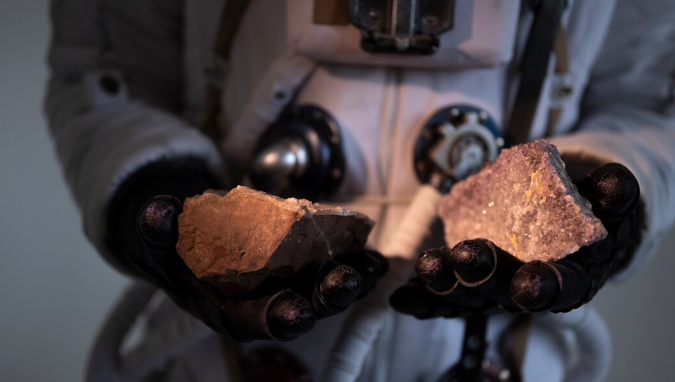
It’s difficult to ignore the implications for the samples that NASA’s Perseverance rover is currently gathering while sealed in titanium tubes on the Jezero Crater floor. The Cumberland findings imply that the chemistry preserved inside ancient Martian mudstone may be both resilient and surprisingly rich, even though those samples haven’t yet reached Earth because the Mars Sample Return mission is still one of the most difficult and costly logistics operations in space exploration history. If fatty acid fragments can withstand radiation exposure for 80 million years and remain detectable, then biosignatures from previous life, if any, may still be present in the rock record.
As all of this develops, there’s a sense that planetary science is at a truly peculiar crossroads, methodically ruling out explanations one by one rather than making a claim of discovery or giving up on the possibility. The true answers usually lie in what’s left after everything commonplace has been ruled out. Sitting in a rover that has been trundling across a crater since 2012, the rock known as Cumberland might still have more to say.