


Listen to the article
There was no fanfare when the signal came. The Wide-field X-ray Telescope on board China’s Tianguan satellite, a spacecraft that most non-astronomers couldn’t distinguish from a lineup, detected an X-ray source on the evening of July 2, 2025. The source brightened so suddenly that the standard survey software had to flag it. Three continents’ worth of telescopes were swinging toward the same area of the sky in a matter of hours. Even seasoned astrophysicists began speaking cautiously by the time the data settled because what they had on their hands was so unfamiliar.
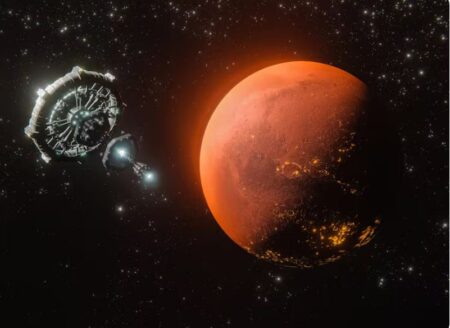
The team at the National Astronomical Observatories of the Chinese Academy of Sciences believes that this is the first time that a white dwarf has been destroyed by an intermediate-mass black hole. The event is now recorded as EP250702a. There’s a lot of work in that sentence. On its own, each piece is unique. When they are combined, the result is nearly theoretical, the kind of thing that physicists talk about in lecture halls but hardly ever expect to witness in real life.
| Mission Information | Details |
|---|---|
| Satellite Name | Tianguan, also called the Einstein Probe |
| Operating Agency | National Astronomical Observatories, Chinese Academy of Sciences (NAOC) |
| Launch Date | 9 January 2024 |
| Primary Instrument | Wide-field X-ray Telescope (WXT) |
| Detection Date | 2 July 2025 |
| Event Designation | EP250702a |
| Event Type | Likely tidal disruption of a white dwarf |
| Suspected Black Hole Class | Intermediate-mass black hole (hundreds to hundreds of thousands of solar masses) |
| Principal Investigator | Yuan Weimin, NAOC |
| Lead Researchers | Zhang Wenda and Jin Chichuan, NAOC |
| Publication Venue | Cover article, Science Bulletin |
| Tidal Disruption Events Observed to Date | More than 100 |
| Wavelengths Followed Up | X-ray, optical, and radio (multi-telescope global campaign) |
Events that cause tidal disruption are not new. Since the first one was clearly confirmed years ago, more than a hundred have been cataloged. However, nearly all of those involved regular gaseous stars being drawn into a supermassive black hole’s gravitational well at a galaxy’s center. As the debris settles into a glowing accretion disk, a massive star, black hole, and slow, agonizing meal illuminates the sky for months or years. That was not at all like EP250702a. It was faster, more violent, and more bizarre than anything found in the current catalog.
When a sun-like star runs out of fuel and silently collapses into a body the size of Earth with the mass of an entire star packed inside, the result is a white dwarf. roughly a million times the Sun’s density on average. Something like that is difficult to disassemble. The math is harsh: only black holes in a particular weight class, ranging from a few hundred to a few hundred thousand solar masses, possess the exact tidal pull required to shred a white dwarf rather than simply engulf it. The black hole is too small below that range. Before anyone can witness anything, the white dwarf above it vanishes beyond the event horizon.
The Chinese team has been extremely cautious in their wording because of this. It’s appropriate that the word “likely” appears in almost all of the announcement’s sentences. With its extreme peak luminosity, ultra-short timescale, and slow soft X-ray afterglow, EP250702a exhibited all the characteristics of a jetted tidal disruption event involving an intermediate-mass black hole. Jin Chichuan, another researcher on the team, used the term “strongly supported.” Zhang Wenda, an associate researcher at NAOC, described it as “compelling.” No one is referring to it as definitive. Still.
Even though the science is the main focus, there is a subtle political component as well. January 2024 saw the launch of Tianguan. It was created in cooperation with European partners and given the name Einstein Probe in honor of the man whose general relativity foretells precisely such occurrences. It is not insignificant to witness a Chinese-led mission make the first observation of a phenomenon that has eluded JAXA, NASA, and ESA for decades. China’s astronomy program has been rapidly catching up; the world’s perception of Chinese scientific infrastructure was altered by the construction of the FAST radio telescope in Guizhou and the discovery of the unusually massive LB-1 black hole in 2019. That arc seems to continue with EP250702a.
The amount that was riding on a single twelve-second flash of light is difficult to ignore. Only because Tianguan detected the burst fast enough to notify everyone else did a follow-up campaign across optical and radio observatories take place. The entire purpose of a wide-field X-ray survey instrument is to be looking up at the sky when something unexpected occurs, but execution differs from design. The finding demonstrated that Tianguan can be “the first to capture the universe’s most extreme moments,” according to project principal investigator Yuan Weimin. That kind of statement typically seems exaggerated. It’s difficult to disagree with this time.
The long-standing question of the origin and frequency of intermediate-mass black holes has not yet been resolved by this discovery. These middleweight objects, which lie awkwardly between the supermassive monsters that anchor entire galaxies and the stellar-mass black holes created when massive stars collapse, have been the subject of years of research by astronomers. One of them might be EP250702a. Perhaps observations in the future will uncover something even more bizarre. Looking at the data, there’s a sense that the question isn’t quite answered; it’s just that, for the first time, someone has the right kind of evidence to begin asking it correctly.