



Listen to the article
The image of a moon the size of Earth floating through interstellar space, totally detached from any star, with dark skies overhead, no sunrise, no seasons, and somewhere below the surface, liquid water flowing through ancient rock, is subtly disorienting. It sounds like a work of fiction. However, in early 2026, a group of researchers at Ludwig Maximilian University of Munich, in collaboration with colleagues at the Max Planck Institute for Extraterrestrial Physics, published findings indicating that this scenario is not only conceivable but could actually be occurring right now, somewhere in a galaxy full of wandering worlds.
Rogue planets, which are free-floating objects expelled from their home systems during the early, violent stages of planetary formation due to gravitational chaos, are not a novel idea. The increasing attention being paid to their moons is more recent and much stranger. According to recent estimates, there are about as many rogue planets as there are stars in the Milky Way. It’s highly likely that some of them have moons. Some of those moons might be the size of Earth. And this research suggests that some of those might be warm enough to retain liquid water on their surfaces for up to 4.3 billion years, which is almost the whole time that Earth has been a living planet.
| Research & Key Information | Details |
|---|---|
| Study Topic | Habitability of moons orbiting free-floating rogue planets |
| Lead Researcher | David Dahlbüdding, doctoral researcher — Ludwig Maximilian University of Munich |
| Institution | LMU Munich & Max Planck Institute for Extraterrestrial Physics (MPE) |
| Published In | Monthly Notices of the Royal Astronomical Society (accepted, also on arXiv) |
| Publication Date | March 2026 |
| Key Finding | Earth-size moon orbiting a Jupiter-like rogue planet could maintain liquid water for up to 4.3 billion years |
| Heat Source | Tidal heating — gravitational flexing generates internal friction and warmth |
| Atmosphere Type Studied | Hydrogen-rich — stable at extremely low temperatures unlike CO₂ |
| Comparison Mechanism | Collision-induced absorption (CIA) — allows hydrogen to trap infrared heat under pressure |
| Solar System Parallels | Enceladus and Europa — subsurface oceans powered by tidal forces |
| Estimated Rogue Planets in Galaxy | Comparable in number to the total count of stars in the Milky Way |
| Potential Life Type | Microbial — chemosynthesis-based, using hydrothermal vent energy rather than sunlight |
| Key Quote | “The cradle of life does not necessarily require a sun.” — David Dahlbüdding |
Starlight is not the source of heat. Gravity is the cause. Here, the same tidal forces that maintain a subterranean ocean sloshing beneath the ice shell of Saturn’s small, geologically restless moon, Enceladus, would be present, but they would be amplified. These rogue exomoons typically have extremely elongated orbits after being ejected from their parent system, which means that the moon is constantly compressed and stretched by the gravitational pull of its host planet. Friction is produced by that mechanical flexing. Heat is produced by friction. It is a slow, unrelenting internal furnace that is completely unaffected by any stars in the vicinity.
The atmospheric question is what distinguishes the new research from previous conjecture. Carbon dioxide could maintain habitable conditions for about 1.6 billion years, according to earlier models that tested it as a possible heat-trapping layer. This is intriguing, but not long enough for complex life to emerge based on Earth’s timeline. The issue with CO2 in these harsh conditions is that it freezes. The story comes to an end when the atmosphere collapses and the moon turns cold. Hydrogen exhibits distinct behavior. It doesn’t condense at temperatures close to those of a rogue planet, and under high pressure, colliding hydrogen molecules can momentarily create structures that can absorb and hold onto infrared heat. This phenomenon is known as collision-induced absorption. It’s an improbable mechanism, and the way hydrogen continues to function when everything else fails is almost unyielding.
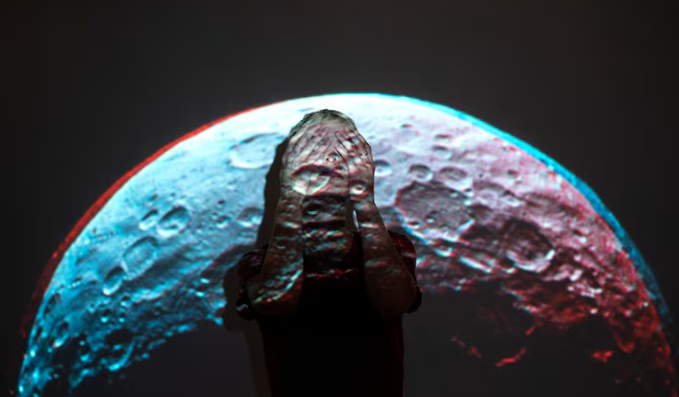
It is difficult not to imagine what life would be like in such a place. No photosynthesis. There is no sunlight penetrating the water. Rather, chemosynthesis—organisms obtaining energy from chemical reactions at hydrothermal vents on an ocean floor, similar to how some microbes do in the darkest, deepest depths of Earth’s own oceans—is the most likely model. ecosystems that have never been exposed to light, have never needed it, and would not be able to identify it. For many years, scientists have known that the deep-sea vent communities on Earth contradict the notion that life depends on the sun. This study takes that challenge to a whole new level: throughout the galaxy, in locations where no telescope has yet to point with any particular hope.
The research team also points to a link to the earliest phase of life on Earth, where the first prebiotic chemistry may have been sparked by hydrogen concentrations produced by asteroid impacts. Although speculative, the parallel is not reckless. Wet-dry cycles, in which water evaporates and then condenses again, can also be produced by tidal forces on these rogue moons. These conditions are crucial for the assembly of complex molecules that eventually give rise to biology, according to many origin-of-life researchers. The difficult question remains whether that chemistry ever leads to real living things. It’s possible that the conditions are present but have no effect. It might be harder to begin life than to maintain it. However, it turns out that the window is open in far more places and for far longer than most scientists would have acknowledged even ten years ago.