


Listen to the article
When scientists witness something that defies their expectations, a certain kind of silence descends upon the room. Not a bewildered quiet. It’s more akin to the silence that follows a lovely event, when nobody wants to be the first to criticize it. Every time the Hubble Space Telescope releases a new image of a blue nebula, that’s about what usually happens. And the most recent ones have done it once more.
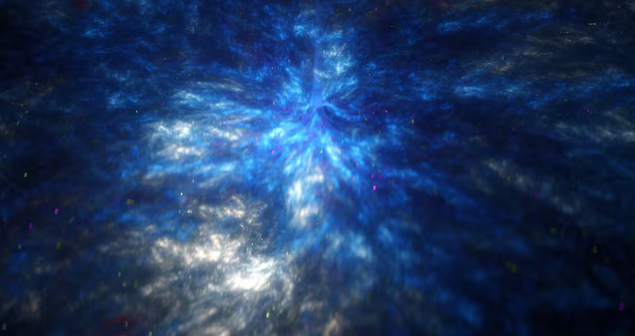
The kind of nebulae that produce that distinctive blue shimmer are called reflection nebulae, and they don’t produce light on their own. Reflection nebulae merely scatter starlight through clouds of fine interstellar dust, in contrast to emission nebulae, which glow because nearby stars ionize their gas and rip electrons loose from hydrogen atoms. It’s similar to shining a torch through fog on a chilly night. The particles are caught by the light, creating a dreamy, electric blue that has given some of Hubble’s most famous pictures an almost surreal quality. The physics is sufficiently understood by scientists. Even so, the images leave them yearning for words that physics is unable to adequately provide.
| Category | Details |
|---|---|
| Telescope | NASA/ESA Hubble Space Telescope |
| Launch Year | 1990 (active for over 35 years) |
| Featured Nebula | Bubble Nebula (NGC 7635) — first discovered in 1787 |
| Nebula Type | Reflection Nebula — appears blue due to light scattering through cosmic dust |
| Key Researchers | Joel Kastner (RIT), Bruce Balick (University of Washington), NASA/ESA teams |
| Closest Pre-Planetary Nebula | Egg Nebula — ~1,000 light-years from Earth, constellation Cygnus |
| Nebula Composition | Primarily hydrogen and helium gas; fine interstellar dust |
| Key Camera Used | Wide Field Camera 3 (WFC3) — full panchromatic imaging |
| Significance | Provides seed material for future star systems; advances understanding of stellar evolution |
| Managing Agency | NASA (USA) & ESA (European Space Agency) — joint mission |
For more than thirty years, Hubble has been doing this to people. Since its launch in 1990, the telescope has spent over 35 years gazing deep into space and retrieving images that have subtly altered humanity’s perception of its place in the universe. One such target is the Bubble Nebula, officially known as NGC 7635. First observed in 1787, it mostly remained in the domain of catalog entries and observatory notes until Hubble rendered it in full detail and revealed something breathtakingly beautiful: a nearly perfect sphere of glowing blue gas, expanding outward from a hot central star like the slow exhale of something enormously old. It’s difficult not to look at it and sense the passage of time in a way that no lecture can fully accomplish.
The Egg Nebula, which is situated in the constellation Cygnus approximately 1,000 light-years from Earth, has recently captured the attention of astronomers. This one’s Hubble imagery is noteworthy for reasons that go beyond aesthetics. The Egg Nebula is a pre-planetary nebula, the precursor to a planetary nebula, which is a dying sun-like star that is releasing its outer layers into space.
NASA refers to it as “the first, youngest, and closest pre-planetary nebula ever discovered,” and that statement is very significant. It’s more than just a lovely cloud. It’s a glimpse of a process that seeded the components of star systems like our own billions of years ago. It feels oddly intimate to watch this develop through Hubble’s most recent imagery, much like learning something significant about your own origins usually does.
Researchers find blue nebulae particularly fascinating because of what they reveal about the internal physical mechanics. Two planetary nebulae, the Butterfly Nebula and the Jewel Bug Nebula, are being studied by a team at the Rochester Institute of Technology under the direction of Joel Kastner using Hubble’s Wide Field Camera 3 in what they refer to as a “dissection.” In short, they can now observe how dying central stars shed and shred their ejected material, where cooler dust takes over and ionized gas predominates, according to Kastner. It turns out that the Butterfly Nebula may have been expelled as recently as 2,000 years ago. That’s essentially last Tuesday in astronomy.
Some of these findings also contain a degree of genuine surprise that prevents the field from becoming routine. Scientists believed they had located the Butterfly Nebula’s central star. They were mistaken; it was an unrelated star that was much closer to Earth and situated between us and the nebula. The true central star is still missing. Even the James Webb Space Telescope, which might try the search next, may not be able to identify it. When science is at its most honest, it acknowledges its ignorance.
Astronomers are stunned by the blue nebula photographed by Hubble, not because they lack vocabulary, but rather because the pictures consistently show how much more there is than anyone first thought. Every new image is a silent but tenacious plea for more viewing. It turns out that the universe is incredibly adept at keeping secrets while making all the hints obvious.