



Listen to the article
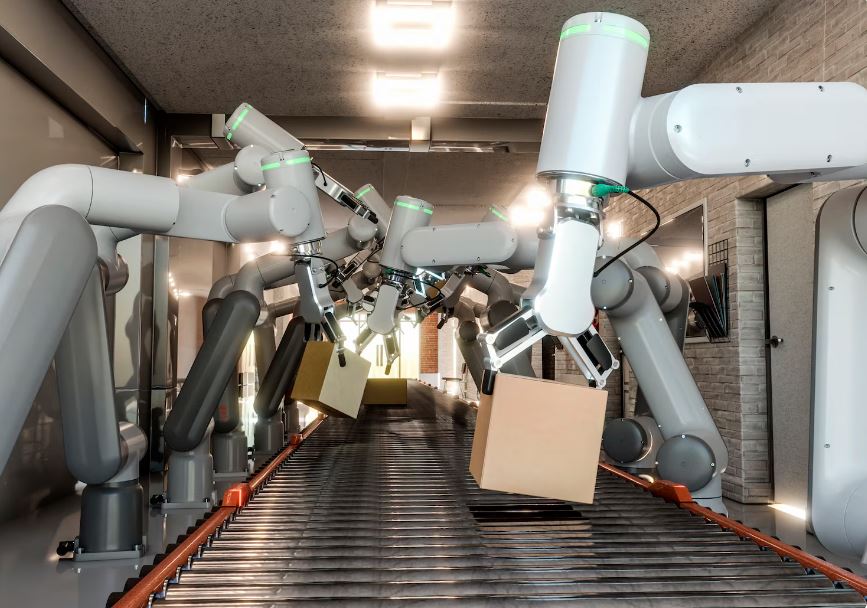
Over the past two years, Riyadh has experienced a low hum that doesn’t quite fit the city’s traditional rhythms. It’s not the buzz of e-scooters close to Boulevard City, the construction noise off King Fahd Road, or the call to prayer. It’s the more subdued sound of factories being designed more quickly than most nations can construct them, and at least some of those factories are being constructed to produce the machinery needed to run other factories. The Saudis are currently attempting to close that loop.
In February 2025, when Amit Midha, CEO of Alat, announced at a forum in Riyadh that Saudi Arabia would start exporting industrial robots by May, the audience responded in a manner typical of Riyadh these days: courteously, but not overly shocked. The Kingdom has been making announcements at a rate that ten years ago would have seemed unreal. But the specificity was what stood out. Self-programming robots. Three to five times faster than a human worker are machines. Constructed in Riyadh and distributed worldwide. It’s the kind of assertion that raises doubts and most likely merits them. The first export shipments did, in fact, depart Riyadh that summer, and the SoftBank joint venture behind it—a deal worth up to $150 million for a fully automated manufacturing hub—is real.
| Riyadh’s Robotics Manufacturing Push — Key Information | |
|---|---|
| Lead Entity | Alat — a Public Investment Fund company |
| Alat CEO | Amit Midha |
| Strategic Framework | Saudi Vision 2030 — National Industrial Strategy |
| Major Partnership (2024) | SoftBank Group joint venture — up to $150 million in industrial robotics |
| Lenovo Partnership Value | $2 billion advanced manufacturing & technology center in Riyadh |
| Lenovo Facility Size | Approximately 200,000 square metres at Riyadh’s Special Integrated Logistics Zone |
| Direct Jobs Anticipated (Lenovo) | 15,000, with 45,000 more across supporting industries |
| Alat 2030 Investment Target | $100 billion across nine business units |
| Robotics Market Forecast | Saudi automation market projected to surpass $2.5 billion by 2030 |
| Startup Funding Reported (2026) | Robotics & automation startups raised over SAR 400 million (~$106 million) |
| Estimated Mineral Wealth | Roughly $2.5 trillion according to Saudi government estimates |
| Tech Investment Anchor Event | LEAP, Riyadh — $14.9 billion in new AI investments announced (2025 edition) |
Until you check the figures, Saudi Arabia’s robotics aspirations seem to be rounded up. By 2030, Alat alone wants to invest $100 billion in technology across nine business units, including semiconductors, electrification, smart appliances, and AI infrastructure. Fifteen minutes from King Khalid International Airport, the $2 billion Lenovo partnership is anchoring a 200,000-square-meter manufacturing and research and development facility in the Special Integrated Logistics Zone. Lenovo anticipates having 15,000 employees there. Fifteen thousand. In a nation whose industrial workforce was, until recently, mostly dependent on oil and petrochemicals, that is the payroll of a small city for a single facility.
The layering is what sets Riyadh’s wager apart from the typical Gulf playbook. Alat, PIF, and the giga-projects are examples of capital that makes headlines, but there is also a more subdued ecosystem of startups that carry out the less glamorous work. Exa Robotics is developing self-sufficient logistics systems that can endure Saudi summer warehouses, where international robots frequently malfunction. Red Sea Robotics is creating inspection robots for the Eastern Province’s oil and gas facilities. Smartr is currently pursuing contracts in the hospitality industry after deploying service robots throughout the entertainment zones of Riyadh Season. According to regional reports, the sector will receive over SAR 400 million ($106 million) in startup funding in 2026. Although that isn’t Silicon Valley money, it’s a significant signal for a sector this young in this market.
Speaking with people in the industry gives me the impression that the true test is still to come. Saudi Arabia possesses the capital, the pipelines for construction, the estimated $2.5 trillion in mineral wealth, and a youthful labor force eager to work in the kinds of jobs created by robotics manufacturing. Decades of industrial muscle memory, the kind of accumulated knowledge that enables Chinese, Japanese, and German plants to quickly iterate on hardware that is more difficult to build than it appears, is something it lacks, at least not yet. In essence, Alat’s wager is that that learning curve can be compressed with partnerships and capital. They might be correct. It’s also possible they’re discovering, like many before them, that robotics manufacturing punishes shortcuts.
The cultural distance the nation has traveled in a short period of time is difficult to ignore. Ten years ago, Aramco and oil exports dominated discussions about Saudi industry. The question now is whether “Made in Riyadh” self-programming robots can compete with those from Shenzhen, Stuttgart, and Yokohama. The next three to five years will determine whether the Kingdom develops into a true manufacturing hub or merely an assembly partner for multinational corporations, as well as whether the talent pipeline keeps up with the capital flow. The factories are currently being constructed. The robots are departing the nation. Furthermore, the hum isn’t going away, for whatever reason.