


Listen to the article
For the majority of us, Saturn’s rings have always seemed to be a part of the solar system’s permanent furniture, existing unaltered since the beginning. They appear antiquated. They appear content. This helps explain why a recent paper from the SETI Institute has such a strange weight. It subtly implies that Titan, the hazy moon that people have been staring at with telescopes for centuries, might not be a single original world at all and that the rings are essentially brand-new in cosmic terms. It might be the outcome of a slow-motion collision.
Matija Òuk, the lead author, has spent years examining the remnants of NASA’s Cassini mission, a spacecraft that circled Saturn for thirteen years prior to its final dive in 2017. Cassini’s final measurements were the kind of information that subtly changes textbooks but doesn’t make headlines. The probe discovered that Saturn’s mass is closer to its core than anyone had anticipated. This small adjustment is significant because it indicates that Saturn’s slow wobble no longer coincides with Neptune’s, which disproves a long-held theory about how Saturn became tilted in the first place.
| Key Information | Details |
|---|---|
| Subject | Saturn’s largest moon, Titan, and the origin of Saturn’s rings |
| Lead Researcher | Matija Ćuk, planetary scientist |
| Institution | SETI Institute, Mountain View, California |
| Study Title | Origin of Hyperion and Saturn’s Rings in A Two-Stage Saturnian System Instability |
| Co-authors | Maryame El Moutamid, Jim Fuller, Valéry Lainey |
| Published In | The Planetary Science Journal (accepted, February 2026) |
| Key Spacecraft Data | NASA Cassini mission, 13-year orbital survey of Saturn |
| Estimated Age of Rings | Roughly 100 million years |
| Suspected Collision Era | A few hundred million years ago |
| Bodies Involved | Proto-Titan and Proto-Hyperion |
| Surviving Evidence | Hyperion’s chaotic tumble and orbital lock with Titan |
| Future Verification | NASA’s Dragonfly mission, arriving 2034 |
| DOI | 10.48550/arXiv.2602.09281 |
In an attempt to close the gap, earlier research from MIT and UC Berkeley proposed a missing moon—something extra that once orbited Saturn but was somehow thrown away. When the SETI team ran the simulations, they consistently received different results. The extra moon was not ejected neatly. It went down. Into Titan.
Reading Òuk’s work gives me the impression that Hyperion was the obvious clue. The peculiar member of Saturn’s family is Hyperion, a lumpy, potato-shaped object that never settles into a steady spin and tumbles end over end as it orbits. It turns out that its gravitational lock with Titan is surprisingly young, only a few hundred million years old—roughly when the moon would have disappeared. Hyperion did not survive the chaos, according to the team’s startling interpretation. It created it. A fragment of the wreck that never came back to life.
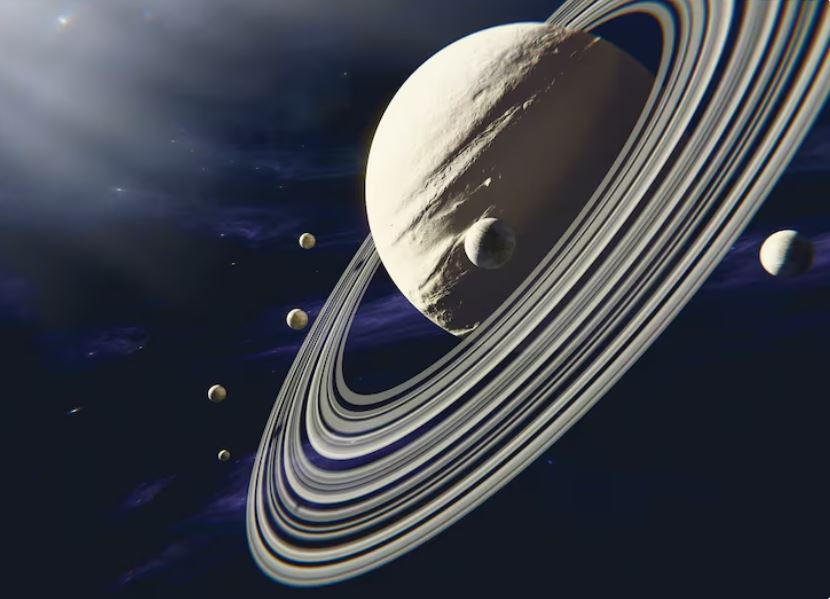
According to this new model, the Titan that exists today is actually the result of the fusion of two earlier moons. Researchers have identified two bodies: Proto-Titan, a larger body that resembles Jupiter’s heavily cratered Callisto, and Proto-Hyperion, a smaller companion. Titan’s face may not have many scars because the collision would have melted it and caused it to resurface. The majority of moons that age ought to have pockmarks. Titan appears strangely tidy, as if it has been reset.
What followed is more difficult to comprehend. Titan, slightly off-balance after the merger, drifted outward, and as it did, its gravity began nudging the smaller inner moons into resonances they couldn’t escape. Their orbits widened. They began bumping into one another. Most of that debris pulled itself back together. Some of it didn’t, and that leftover material, ground down and spread thin, became the rings. If the timing holds, the rings are roughly the age of the dinosaurs — younger than flowering plants on Earth, which is a strange thought to sit with.
It’s still unclear, of course, whether all the pieces fit. The geology will have the final word. NASA’s Dragonfly, an octocopter set to land on Titan in 2034, is built to study the moon’s surface chemistry, and if it stumbles across signs of a colossal resurfacing event roughly half a billion years old, the case becomes very hard to argue against. Until then, there’s something almost humbling about the idea. The rings everyone has admired for four hundred years may turn out to be debris from a quiet catastrophe, still settling.