



Listen to the article
Driving in Abu Dhabi these days feels like you’re being watched, but not in the oppressive way you might anticipate. If you’re driving down Sheikh Zayed Road on a Tuesday afternoon, there aren’t any noticeable changes. The traffic is moving. The signals fulfill their purpose. However, beneath that unremarkable exterior, a vast amount of machine learning is sorting through each lane change, brake tap, and instance in which a driver uses a phone for a half-second too long.
These are the kinds of numbers that make traffic engineers take notice. Speaking at Gulf Traffic Week, officials said that since 2019, the percentage of speed-related accidents in the emirate has decreased from 15% to 9%. Since 2011, the overall number of road deaths has decreased by 73%. It’s not a slight improvement. That’s a generational shift, and it wasn’t brought about by fines or signs warning people to buckle up.
| UAE Smart Traffic AI Programme — Key Information | Details |
|---|---|
| Lead Authority | Abu Dhabi Police |
| Supporting Body | Integrated Transport Centre, Abu Dhabi |
| National Oversight | UAE Ministry of Interior |
| Speed-Related Accident Reduction | From 15% (2019) to 9% (2026) |
| Weather-Related Crash Reduction | 50% drop after smart speed-control rollout |
| Emergency Vehicle Signal Range | Up to 400 metres |
| Pedestrian Accident Drop | From 18% (2023) to 13% (2025) |
| Road Death Reduction Since 2011 | 73% |
| Regional Ranking | 1st in MENA region for road safety |
| Global Ranking | 8th worldwide (lowest fatalities per 100,000) |
| 2030 Target | Top five safest jurisdictions globally |
| Long-Term Vision | Zero traffic fatalities by 2040 |
A fog was partly to blame. Authorities were forced to pose the awkward question, “Why are we still relying on drivers to notice the weather?” following a 76-vehicle pile-up caused by abrupt low visibility last year. The solution they developed is a system that automatically detects rain, fog, and dust, lowers speed limits in real time, and sends out alerts before cars enter the danger area. Since the rollout, weather-related crashes have decreased by half, according to officials. The early data is impressive regardless of whether those numbers smooth out over a longer period of time.
Additionally, there is a more subdued aspect of the puzzle that ambulance drivers in particular seem to value. In Abu Dhabi, emergency vehicles can now communicate with traffic lights up to 400 meters away. Before they get there, the signal turns green. No more maneuvering through cross-traffic at intersections or leaning on the horn at a red light. Technically, it’s a minor fix, but you can see why it matters if you’ve ever seen an ambulance crawl through traffic.
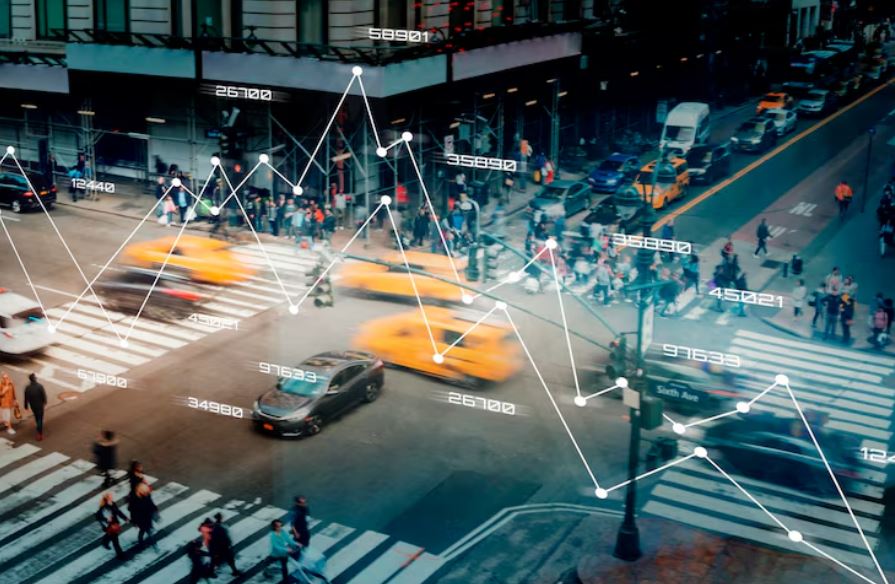
At the national level, the UAE Ministry of Interior is taking a slightly more philosophical approach. Although it does catch speeders, the new AI traffic monitoring system that was introduced earlier this year isn’t primarily focused on doing so. Instead of just piling up fines, it’s about categorizing drivers based on behavioral risk, flagging repeat offenders, and encouraging them to participate in awareness and training programs. The wager is that human behavior is the variable that needs to be solved because infrastructure can only do so much. Observing this, it seems as though the nation has determined that punishment isn’t the best teacher.
The framing is important as Abu Dhabi’s Integrated Transport Center discusses a “Vision Zero”—no traffic fatalities by 2040. The move, according to Sumaya Al Niyadi, head of the center’s traffic safety division, is a change from reactive to proactive: anticipating where accidents will occur rather than cleaning up after them. maps of heat. computer vision. predictive models that identify intersections before they become unsightly. Singapore and some regions of Scandinavia have been doing this for years, but the UAE is doing it more quickly and loudly.
It’s difficult to ignore the attention being paid by the rest of the Gulf. Using its own RTA smart systems, Dubai reports a 20% reduction in travel times along some corridors and a 50% decrease in pedestrian fatalities in the last months of 2025. It remains to be seen if the UAE will truly rank among the top five safest countries in the world by 2030. However, statistically speaking, the roads continue to get quieter, and most cities would welcome that level of quiet.