




Listen to the article
If the researchers are correct, a tiny bright patch close to a lunar crater’s edge has been sitting quietly in plain sight for sixty years. A smudge in a high-resolution image captured by NASA’s orbiting camera is the kind of detail you could scroll past without giving it much thought. However, the team that discovered it believes that smudge could be the long-lost Soviet Luna 9 spacecraft, which was the first human-made object to land softly on another planet.
On February 3, 1966, Luna 9 descended in a manner that, by today’s standards, sounds almost comical. After tumbling across the lunar surface on built-in shock absorbers, the spacecraft settled somewhere, though no one could ever be certain. It then sent pictures home for roughly 36 hours before going silent. It was the height of the Cold War. The Americans continued to pursue. Additionally, the landing’s precise coordinates, which were determined using tracking technology from the 1960s, turned out to be off by up to several dozen kilometers. Even with contemporary orbital cameras, a search becomes a needle-in-a-haystack problem due to such a large margin.
| Information | Details |
|---|---|
| Discovery Type | Possible identification of “lost” Soviet Luna 9 spacecraft |
| Original Mission | Luna 9 — Soviet Union |
| Year of Original Landing | 3 February 1966 |
| Historical Significance | First soft landing of human-made object on another celestial body |
| Operational Duration on Moon | ~36 hours |
| Suspected Coordinates | 7.02907° N, −64.32867° E |
| Imaging Technology Used | YOLO-ETA (adapted from TinyYOLOv2) |
| Detection Confidence Score | ~80% |
| Source of Imagery | NASA’s Lunar Reconnaissance Orbiter Camera (LROC), deployed 2009 |
| Lead Researcher | Lewis Pinault, University College London |
| Co-Researchers | Hajime Yano, Ian Crawford |
| Search Region Analyzed | 5 × 5 km area |
| Published In | npj Space Exploration |
| Verification Mission | India’s Chandrayaan-2 orbiter (next pass) |
| Original Landing Estimate Error | Up to several dozen kilometers |
Lewis Pinault at University College London, along with colleagues Hajime Yano and Ian Crawford, oversaw the new project, which relied on a tool known as YOLO-ETA. “You-Only-Look-Once — Extraterrestrial Artefact” is the name, which has a deadpan academic charm. Initially trained on the famous Apollo landing sites, the lightweight machine-learning system allowed the team to confirm whether the algorithm was truly seeing what it claimed to see. They pointed it at the rough area where Luna 9 was believed to have landed once it reached about 80% confidence in identifying man-made hardware in NASA’s Lunar Reconnaissance Orbiter imagery.
It discovered a primary impact feature with a luminous patch close to one edge near 7.03° N and –64.33° E, along with a number of smaller features clustered nearby that the researchers believe may be debris. That has a poetic quality. A spacecraft that broke records, outperformed the Americans, and then silently vanished from history for sixty years may now be recognized by a few hundred lines of computer code rather than by human eyes.
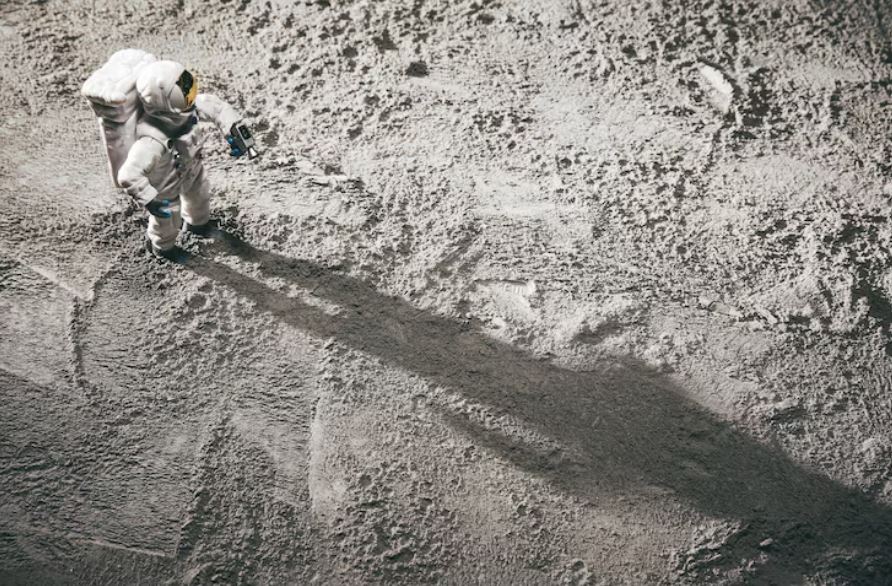
Here, it’s worth being a little cautious. Although the results have not yet been verified, the researchers themselves are certain that additional imaging is required. Soon, India’s Chandrayaan-2 orbiter is scheduled to fly over the region, which could either confirm the identification or force everyone to start over. As you watch this happen, you can’t help but wonder how many other lost missions—Soviet, American, and otherwise—are still strewn all over the lunar surface, half-buried under decades of micrometeorite dust, just waiting to be discovered by someone or something with patient eyes.
There is also a more general undercurrent to be aware of. The Moon will soon become much more crowded. More than a hundred space agencies and private operators are interested in NASA’s Artemis program, which is getting ready to return astronauts to the surface, for a variety of purposes, including permanent bases and water ice mining. Building tools that can accurately catalog what’s already up there—old hardware, debris, potential historical sites—becomes more than just a curiosity in that situation. There’s a feeling that the next stage of lunar exploration will involve more than just traveling. It will be about recalling what has already been left behind.
If Pinault and his team are correct, the solution to one of the more subdued mysteries of the Cold War will come from an algorithm that is patient enough to keep searching rather than from a spectacular recovery mission. For some reason, that seems perfectly appropriate for the time we are in.