




Listen to the article
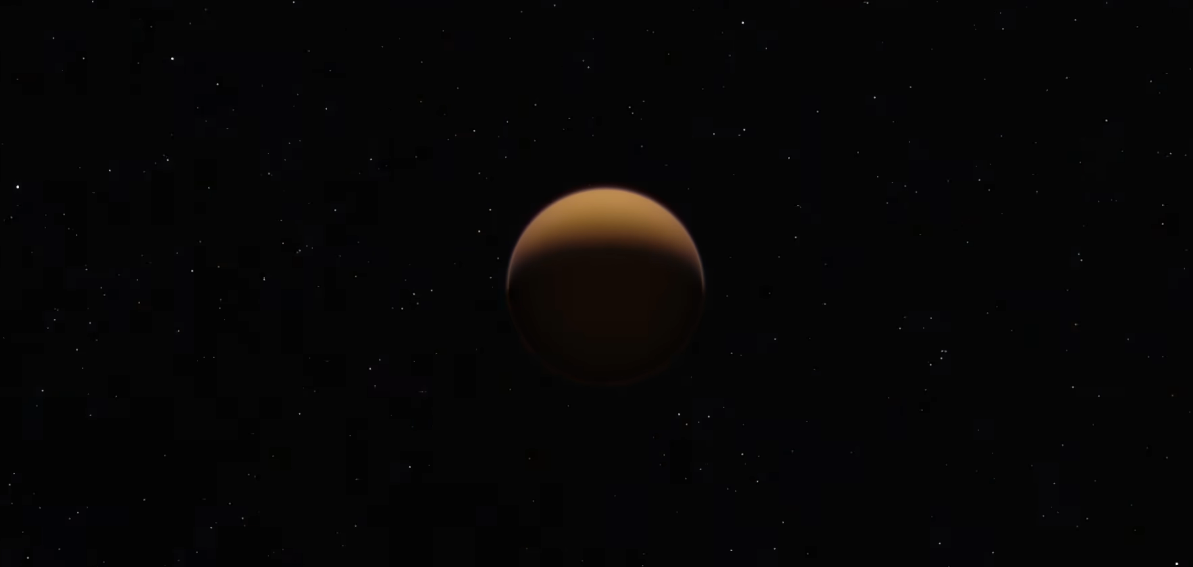
Titan orbits farther out, moving with steady confidence, whereas Saturn has always handled itself with a sort of serene authority, its rings creating a faint aura that seems almost meticulously formed. Astronomers thought Titan was a very stable partner for decades because it formed early and stayed mostly unaltered, its thick orange haze concealing secrets that instruments could only gradually uncover.
As researchers in orbital mechanics discovered patterns that seemed remarkably comparable to systems formed by disruption rather than peaceful assembly, that long-held notion is now being carefully reexamined. Through the use of sophisticated simulations to reconstruct Titan’s past, scientists discovered evidence that suggests the planet’s current shape might have resulted from a huge collision that was strong enough to alter its trajectory and structure.
The most convincing hint for planetary scientists came from Hyperion, a smaller moon that orbits Titan in a rhythm that is roughly related to Titan’s. With gravitational interactions that seem far younger than anticipated for objects thought to have created billions of years ago, their relationship is especially novel as a natural record of timing.
Scientists discovered that Titan’s orbit had undergone a substantial change hundreds of millions of years ago, indicating a disruption that transformed the system, by examining that relationship. Researchers were able to focus on a time when Titan’s serene exterior most likely belied a much more chaotic past thanks to this discovery, which was very successful at reducing the chronology.
| Key Fact | Details |
|---|---|
| Object | Titan, Saturn’s largest moon |
| New Theory | Formed from a collision between two earlier moons |
| Estimated Timing | Collision may have occurred 400–500 million years ago |
| Supporting Evidence | Titan’s orbit, surface features, and Hyperion’s unusual behavior |
| Related Phenomenon | Saturn’s rings may have formed from collision debris |
| Key Mission | NASA’s Dragonfly mission planned to arrive in 2034 |
| Scientific Importance | May reshape understanding of moon and planetary evolution |
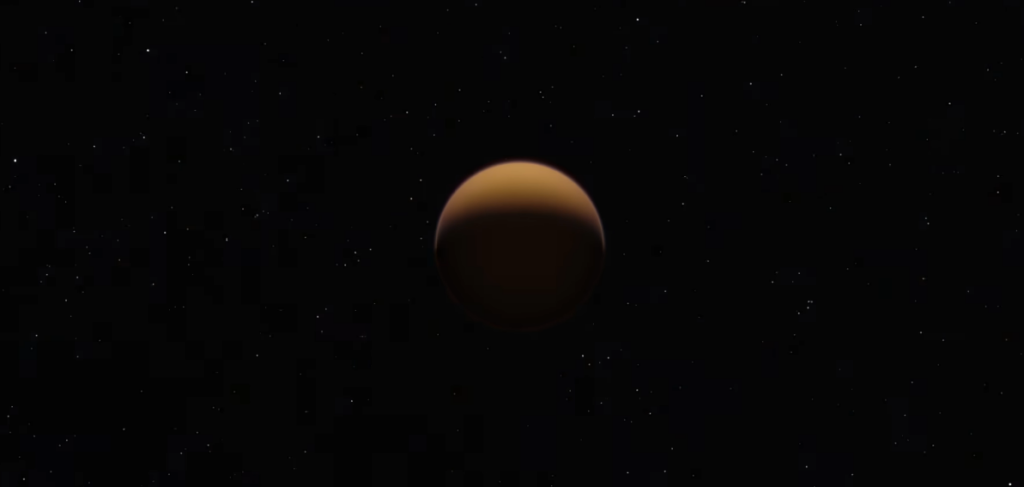
Scientists investigated the possible causes of this shift using computer models, and they consistently discovered that a collision between Titan and another moon provided the most logical explanation. According to those simulations, a medium-sized satellite slid into Titan’s orbit and eventually merged with it, unleashing a tremendous amount of energy that changed the topography, melted crust, and significantly strengthened Titan’s structural integrity.
The concept feels strangely intimate to people who grew up viewing textbook depictions of Titan as a flawless survivor, as though a well-known monument subtly held evidence of an ancient scar that was only now revealed.
Titan’s surface exhibits fewer impact craters than one might anticipate for an ancient body exposed to space junk, which is likewise explained by that collision scenario. Titan’s outer layers would have been heated and sculpted by absorbing another moon, greatly minimizing ancient crater markings and creating a smoother terrain that scientists previously found difficult to explain.
Given that debris thrown inside may have created frozen shards that currently orbit the planet, the collision may also have had a particularly creative influence on the formation of Saturn’s rings. Given that measurements indicate the rings developed very recently as comparison to Saturn itself, that option is especially helpful in settling arguments regarding the rings’ age.
Since the porous, uneven form of hyperion resembles material that developed from scattered fragments rather than intact formation, its unique structure lends further credence to this view. Researchers came to the conclusion that Hyperion might be remains of the impact, demonstrating how devastation can also be reconstructed.
In conversations with scientists years ago, I recall their subdued interest in Hyperion, referring to it as a witness instead of just another moon.
Titan’s current motion provides remarkably unmistakable evidence that its past is dynamic rather than static. Titan is moving outward more quickly than previous models indicated, indicating that gravitational adjustments have not yet entirely resolved, according to scientists who measured its orbit precisely.
Since the tidal interactions between Titan and Saturn gradually modify its route, restoring equilibrium while conserving remnants of previous upheaval, this outward drift is extremely effective proof of past disruption. Scientists may recreate events long after they have happened because to those small modifications, which are especially inventive signs.
The consequences are far better for planetary science, providing a better understanding of the evolution, merger, and transformation of massive moons throughout time. Titan’s tale exemplifies highly adaptable processes, showing how collisions can create sturdy, long-lasting structures rather than just destroying them.
It is anticipated that future exploration will yield astonishingly effective solutions, particularly when NASA’s Dragonfly mission arrives on Titan’s surface in 2034. Direct examination of Dragonfly’s chemistry and geology may reveal traces of previous melting, mixing, and restructure, providing very robust proof in favor of or improvement upon the collision theory.
Titan’s rewritten genesis tale gives something even more important than closure to aspiring young scientists: opportunity. It demonstrates how carefully challenging long-held beliefs can result in revelations that pique interest and advance understanding.
The speed at which simulation technology has advanced over the last ten years has made it possible for scholars to rebuild cosmic history with astounding accuracy. These tools, which turn abstract theories into visual narratives depicting moons colliding, merging, and stabilizing over time, have been very helpful.