


Listen to the article
The fact that scientists can extract a hitherto unidentified animal from one of the least visited locations on Earth—six and a half kilometers below the Pacific surface—and discover a piece of soda bottle inside it speaks volumes about the contemporary ocean. That is essentially what Eurythenes plasticus experienced. The thumbnail-sized amphipod got its name from the contamination that resulted from it. The Newcastle University expedition’s leader, Dr. Alan Jamieson, explained why. The name is affixed to the species itself as a sort of warning sign.
The plastic found inside was PET, the same kind of plastic found in inexpensive T-shirts and disposable water bottles. This is the peculiar, depressing aspect of this tale. Pollution doesn’t travel along some far-off industrial path. It passes through commonplace items that most people use without giving them much thought—the kinds of things that are put in recycling bins or kept in small refrigerators in hotel rooms. After the United States and Japan, Germany is the third-largest exporter of plastic waste, and a large portion of that waste is never recycled, according to Heike Vesper of WWF Germany. It burns. or buried. or eventually cleaned.
| Key Information | Details |
|---|---|
| Species | Eurythenes plasticus, a deep-sea amphipod (about 5 cm long) |
| Discovery Location | Mariana Trench, near the Philippines, roughly 6,500 metres deep |
| Lead Researcher | Dr. Alan Jamieson, Newcastle University |
| Plastic Identified in Body | Polyethylene terephthalate (PET) — found in bottles, textiles, packaging |
| Original Discovery Publication | Journal Zootaxa |
| Supporting Organization | WWF Germany, statement from Heike Vesper |
| Atlantic Study | Bathydemersal fish from the Porcupine Bank, 985–1,037 m depth |
| Atlantic Species Examined | Alepocephalus bairdii and Coryphaenoides rupestris |
| Microdebris Prevalence | 28% in both species sampled |
| Annual Plastic Entering Oceans | An estimated 8 million tons (2015 figure) |
| Visible Surface Plastic | Roughly 1% of total ocean plastic |
| Related Research Hub | Woods Hole Oceanographic Institution marine microplastics program |
| Reported Threat Range | Over 1,200 marine species affected globally |
In popular perception, the deep sea is thought to be unspoiled. Some places are just too far away, too cold, or too dark for our problems to reach, according to a subtle assumption ingrained in nature documentaries. That presumption is quickly falling apart. Microdebris was discovered in 28% of fifty fish that were removed from the Porcupine Bank in the North Atlantic between 985 and 1,037 meters below the surface, according to a 2022 study by Spanish researchers. A clear PET filament was curled in the stomach of one specimen, Alepocephalus bairdii. These animals don’t interact with the outside world very often. Nearly no human will ever see the cold, dark water in which they spend their entire lives.
The volume is more difficult to comprehend. Estimates that have held up fairly well over the past ten years indicate that approximately eight million tons of plastic enter the oceans annually. At the surface, only around 1% of that is visible. The remainder settles, sinks, drifts, breaks, and is consumed. At every depth they sampled, underwater robots from MBARI in Monterey Bay discovered microplastics, with PET being the most prevalent type once more. When all of this is taken into consideration, it seems as though the visible trash patches that everyone has seen photos of are the smallest, most noticeable aspect of a much bigger and more bizarre issue.
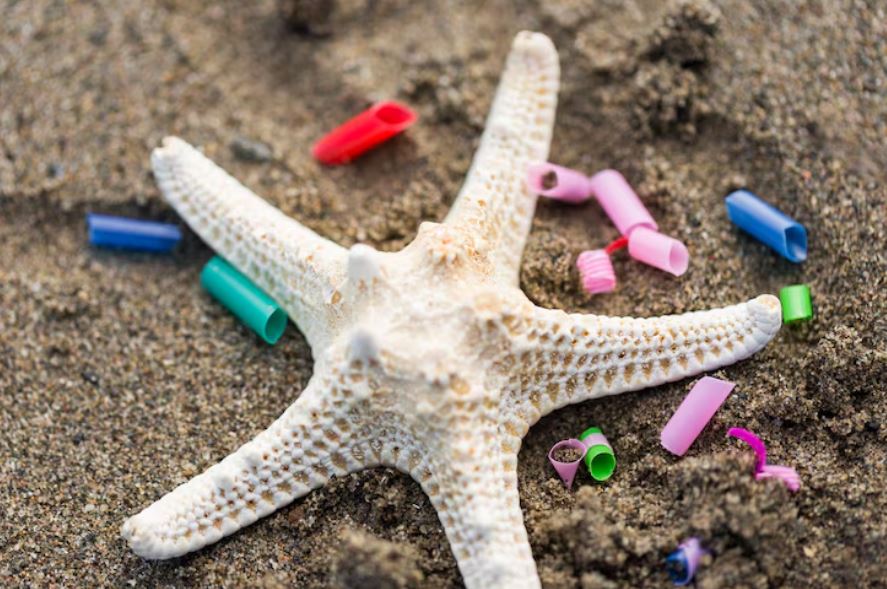
What any of this does to the animals that carry it is a more difficult question. To be honest, scientists are still unsure. Plastics are more than just plastics; they also contain trace chemicals, flame retardants, and plasticizers that may be carried by nearby water. For years, researchers have been monitoring these substances in marine animals, and there is mounting proof that they ascend the food chain and end up in the fish that humans eat. Whether the levels are high enough to harm systems or whether some species and ecosystems will adapt or quietly collapse is still up in the air.
Reading about a creature that was given its scientific name in part because it had already ingested our trash makes it difficult to avoid experiencing something akin to grief. None of this was selected by Eurythenes plasticus. Jamieson pointed out that some of the specimens gathered by his team were still plastic-free. More than any one statistic, the question of whether the next generation will be is what gives this entire narrative its significance.