


Listen to the article
It’s simple to ignore a certain point in the history of the planet. The Earth, half-molten and still young, whirling in a mist of meteor dust and volcanic gases. Lighter materials drift upward, while heavy metals sink toward the center. It would have appeared more like a slow-motion industrial accident than a cradle of life. However, something subtly went well.
Scientists now believe that a very particular chemical balance that took place during this chaotic phase about 4.6 billion years ago may be responsible for the existence of life on Earth. not a widespread ailment. Not just warmth or water. Something much more constrained. a specific oxygen content that kept nitrogen and phosphorus, two otherwise delicate elements, close to the planet’s surface. Most planets might never be able to pull off this trick.
| Category | Details |
|---|---|
| Study Topic | Chemical conditions required for life to emerge on rocky planets |
| Lead Researcher | Craig Walton |
| Institution | ETH Zurich |
| Focus Elements | Phosphorus and Nitrogen |
| Key Concept | Planetary “chemical Goldilocks zone” during core formation |
| Planet Formation Era | ~4.6 billion years ago |
| Published In | Nature Astronomy |
| Implication | Many habitable-looking planets may still lack chemistry for life |
| Example Comparison | Mars likely missed the chemical balance |
| Reference | https://www.nature.com |
ETH Zurich researcher Craig Walton has been simulating the chemistry of early planetary formation, and the findings point to something unsettling. Oxygen concentrations dictate where various elements end up during the formation of a planet’s core. Too little phosphorus and oxygen forms bonds with iron, causing it to sink far into the core, beyond the reach of life. Too much oxygen and nitrogen escapes into space.
From a distance, the planet appears completely normal in both cases. Rocky. Perhaps even damp. but sterile in terms of biology. It seems as though Earth may have threaded a tiny needle when observing how delicate that balance is.
Life as we know it depends on phosphorus. It carries energy through molecules like ATP, forms the backbone of DNA and RNA, and aids in the construction of cell membranes. Proteins and amino acids are shaped by nitrogen, which is equally significant. Biology has very little to work with in the absence of both elements remaining in a planet’s crust and mantle.
According to Walton’s models, Earth landed in what scientists refer to as a chemical Goldilocks zone, which is an oxygen concentration that is neither too high nor too low. a small window. If you miss it just a little, the chemistry breaks down. Whether this balance is typical throughout the galaxy is still unknown.
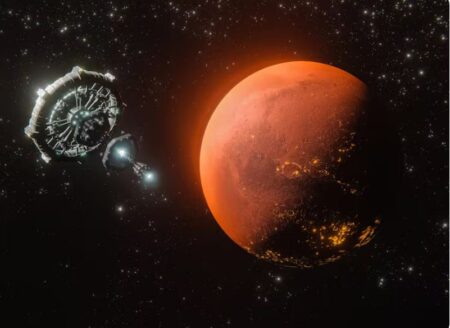
The formation of planets is chaotic. While heavier elements sink inward to form metallic cores, young worlds start out as molten spheres. Small variations in oxygen concentrations can change a planet’s entire chemistry during that turbulent process. The margin appears surprisingly thin when viewed on paper. Mars seems to have lost the balance as well.
Compared to Earth, the red planet’s mantle probably contained more phosphorus but significantly less nitrogen. That may not seem disastrous at first glance. However, it most likely left Mars with a chemistry incapable of sustaining sophisticated biology. Imagining the dry valleys and oxidized dust of Mars today, it’s difficult not to wonder if a minute chemical difference billions of years ago silently sealed the planet’s doom.
For many years, researchers looking for extraterrestrial life concentrated on the habitable zone—the area of a star’s orbit where liquid water can exist. It was a neat concept. Life may follow if you locate planets that are the proper distance from their stars. This new research complicates that picture.
Even if a planet were to orbit comfortably within the habitable zone, it would still lack the internal chemical components required for life. Water is insufficient on its own. The proper elements must be stocked in the planetary kitchen, and those elements must endure the harsh initial stages of planetary formation.
As a result, astrobiology is undergoing a subtle change. Scientists are starting to examine the chemistry of stars in greater detail. Since planets are formed from the same cloud of material as their host stars, the composition of stars can reveal whether or not nearby worlds ever had a chance at life.
The planets that form around a star may never put together the right components if the star’s chemistry is off. The prioritization of targets for upcoming telescopes is altered by this possibility.
In the meantime, hints regarding Earth’s early life continue to surface in unexpected locations. For example, scientists have examined seaweed fossils in Canada’s Yukon Territory that date back almost a billion years—remains of some of the planet’s earliest complex organisms. Pressed into old rock, they appear modest, almost unremarkable. However, because those early chemical conditions somehow worked out, they represent ecosystems that existed. It’s difficult to look at such fossils without experiencing a slight sense of improbability.
Life’s earliest phases are still a mystery. Although the precise process of life’s emergence is still stubbornly unknown, scientists know that it started within a few hundred million years after Earth cooled. Lifeless chemistry somehow arranged itself into self-replicating cells. It is still up for debate whether or not that sequence was unavoidable. That question contains a subtle tension.
On the one hand, there are trillions of planets and billions of galaxies in the universe. It is tempting to assume that life must be typical based only on that scale. However, research like Walton’s continues to show how many conditions had to be met on Earth long before the first microbe emerged. Wherever chemistry permits, life may arise with ease. However, it’s also possible that Earth was just fortunate.