


Listen to the article
At the edge of the Arabian desert, something subtly amazing is taking place. Farming was never supposed to make much sense in places like Al-Qassim, where summer temperatures frequently reach 45 degrees Celsius and rainfall can completely stop for months. However, what was once little more than sand and wind is now covered in row after row of wheat crops and date palms. Artificial intelligence is becoming more and more different.
From the beginning, Saudi Arabia’s Green Initiative has been ambitious. Announced under Crown Prince Mohammed bin Salman’s Vision 2030 framework, it carries a $187 billion price tag and a target to plant 10 billion trees by 2030. The size of those numbers makes them sound almost theatrical. But walking through the initiative’s actual implementation — the monitoring systems, the satellite data layers, the soil sensors humming away in agricultural test zones — it becomes harder to dismiss this as political theatre. Here, something genuine is being constructed.
| Category | Details |
|---|---|
| Initiative Name | Saudi Green Initiative |
| Launched By | Crown Prince Mohammed bin Salman |
| Year Launched | 2021 |
| Total Investment | $187 billion |
| Tree Planting Target | 10 Billion Trees by 2030 |
| Annual Carbon Reduction Goal | 20 Million Tonnes by 2030 |
| Renewable Energy Target | 50% Clean Electricity by 2030 |
| Net Zero Goal | 2060 |
| Key Agricultural Regions | Al-Qassim, Riyadh |
| Water Stress Ranking | 3rd Most Water-Stressed Country Globally (FAO) |
| Carbon Emission Reduction via CSA | Up to 12% |
| Jobs to Be Created | 700,000 (direct and indirect) |
| Key Framework | Saudi Vision 2030 |
| Area of Saudi Arabia | 2.15 Million Square Kilometres |
The agricultural piece of this puzzle is where AI becomes most visible, and most necessary. Saudi Arabia ranks third in the world for water stress, according to FAO data, with annual rainfall averaging below 100 millimetres across most of the country and evapotranspiration rates exceeding 2,000 millimetres per year. To put it simply, the nation loses water to the atmosphere far more quickly than it can be replenished by rain. For many years, the Kingdom made up for it by using deep, non-renewable aquifers, but this was always a temporary fix. AI-driven irrigation systems are now attempting to change that equation, using soil moisture sensors, weather modelling, and crop-specific algorithms to reduce water use without sacrificing yield. Studies covering Saudi agricultural regions between 2010 and 2024 found that smart irrigation was positively and significantly associated with improvements in water-use efficiency — effects that appeared to grow stronger over time, as farmers and systems adapted together.
It’s important to consider the phrase “grew stronger over time.” Much of the optimism around AI in agriculture assumes immediate, dramatic gains. Something more gradual and possibly more durable is suggested by the Saudi data. Technology assimilation takes time. Local conditions are mapped, systems are calibrated, and farmers gain knowledge. The improvements compound one another. That is more akin to the establishment of an institution than a tale of rapid change.
The Saudi Data and AI Authority has been working alongside the Green Initiative specifically to identify optimal planting locations for the 10 billion tree target. Satellite imagery and remote sensing allow AI systems to detect early signs of land degradation and model where restoration efforts have the best chance of success. This matters enormously: it’s estimated that salinization alone has reduced crop yields by up to 38 percent in some parts of Saudi Arabia, particularly affecting dates and fodder crops. Planting trees in the wrong places, or irrigating land already compromised by salt accumulation, simply accelerates the problem. Getting the location decisions right — that’s where AI is doing some of its most unglamorous but consequential work.
There is also a broader ecological dimension that tends to get less attention than the farming statistics. Saudi climate envoy Adel Al-Jubeir, speaking at the COP16 summit in Riyadh, framed land degradation not merely as an environmental problem but as a security one. “When people cannot grow food, they migrate,” he stated. That migration, he argued, creates tension and conflict in receiving regions — a cycle that touches food security, national security, and biodiversity simultaneously. Saudi Arabia’s effort to reverse land degradation using AI-guided restoration is, in this framing, also a regional stability project. It’s still unclear whether the international community fully grasps that dimension.
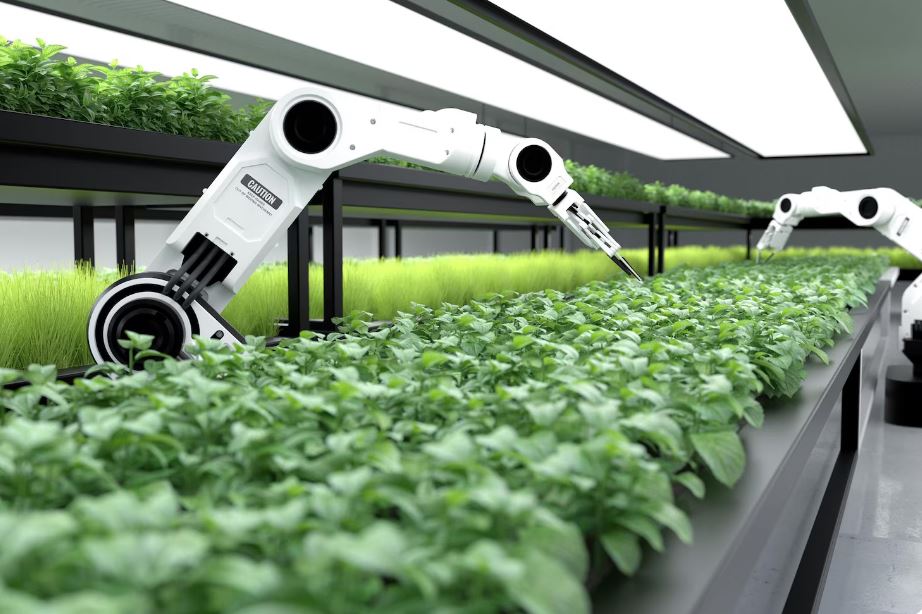
The initiative’s implementation follows a five-phase roadmap running from 2021 through 2030. The early phases focused on institutional setup and pilot projects — the unglamorous foundation work. Phase 3, covering 2026 and 2027, is meant to incorporate new technologies including carbon capture facilities and smart city energy management. Riyadh and Jeddah already use AI systems to regulate energy consumption and manage waste; urban carbon footprints in those cities have reportedly dropped by around 40 percent compared to conventional city planning approaches. The ambition, it seems, is to make the same logic work at the farm level.
There’s a feeling that Saudi Arabia is betting heavily on being a fast follower — taking technologies developed elsewhere and deploying them at a scale that others can’t easily match. The $15 billion Circular Carbon Economy National Program, the $5 billion NEOM green hydrogen project generating 650 tonnes of carbon-free hydrogen daily, the research into direct air capture — each of these represents an attempt not just to reduce emissions locally but to position the Kingdom as a technology exporter in a decarbonising world. A $25 billion annual market for domestically developed climate solutions by 2035 is the stated goal. Whether that target is realistic is genuinely uncertain, but the infrastructure being built to pursue it is not imaginary.
Research from peer-reviewed studies synthesising Saudi agricultural data found that the most widely adopted climate-smart practices — climate-resilient crop varieties appearing in 52 percent of reviewed studies, efficient drip and sprinkler irrigation in 46 percent — were concentrated precisely in the most water-scarce regions. That’s not surprising, but it matters: it suggests adoption is being driven by genuine necessity rather than government subsidy alone. Farmers in Al-Qassim aren’t using precision irrigation because someone told them to. They’re using it because the alternative is watching their crops fail.
Saudi Arabia has signed bilateral cooperation agreements with more than 15 countries, exchanging best practices and co-funding projects. The Green Climate Fund, the World Bank Group, and the UN Environment Programme are all involved. For a country that built its global reputation almost entirely on petroleum, this pivot is — whatever its complications — a genuine shift in self-presentation and, apparently, in commitment. Whether the ambition survives the complexity of actual execution over a decade-long timeframe is, ultimately, the only question that will matter.