


Listen to the article
The information dates back to 1992. After its mission ended, the spacecraft that collected it was purposefully sent plunging into Venus’s atmosphere, and it has been dead for more than thirty years. However, in February 2026, a group of Italian researchers in Trento published a discovery that would have seemed remarkable even if they had only gathered the data the previous week: direct radar evidence of a massive underground lava tube buried beneath Venus’s surface, about a kilometer wide, with a void extending at least 375 meters into the dark beneath a roof more than 150 meters thick. Even after thirty years of observation, Earth’s most familiar geological neighbor—the planet that scientists have referred to as our “twin” for generations—continues to astound observers.
The building is located beneath the western flank of Nyx Mons, a volcanic feature named after the Greek goddess of night. There are about 1,600 major volcanoes on Venus’s surface. NASA’s radar mapping orbiter, the Magellan spacecraft, circled Venus for two years between 1990 and 1992. It took pictures by reflecting radio waves off the planet’s surface and measuring their return. Conventional cameras are useless on Venus due to its constant cloud cover; radar is the only method available. Even now, the most comprehensive surface map of Venus is based on the information that Magellan gathered.
In order to find the unique signatures that collapsed lava tube roofs typically produce, Professor Lorenzo Bruzzone and his colleagues at the University of Trento used a specialized imaging technique on those archived radar returns. They discovered one close to Nyx Mons. The exact radar pattern they were searching for was produced by a skylight, a collapsed portion of the lava tube’s ceiling.
| Discovery | First confirmed subsurface lava tube on Venus — identified in the Nyx Mons volcanic region (named after the Greek goddess of night); only the second lava tube ever reported on the planet |
|---|---|
| Research Institution | University of Trento, Italy — led by Professor Lorenzo Bruzzone, head of the Remote Sensing Laboratory, Department of Information Engineering and Computer Science; funded by the Italian Space Agency; published February 9, 2026 in Nature Communications |
| Data Source | Radar images from NASA’s Magellan spacecraft — which orbited Venus from 1990 to 1992 using a Synthetic Aperture Radar (SAR) system capable of penetrating Venus’s permanent cloud cover; the data is over 30 years old |
| Structure Dimensions | Estimated diameter: approximately 1 kilometer wide; roof thickness: at least 150 meters; void depth: no less than 375 meters; estimated total length of the subsurface conduit: at least 45 kilometers (based on terrain morphology and nearby pit chains) |
| How It Was Found | Researchers applied a specialized imaging technique to detect and analyze surface collapses (“skylights”) near the Nyx Mons shield volcano — the opening into the lava tube roof produced a distinctive radar signature matching known collapsed lava tube structures on other worlds |
| Why Venus Favors Large Tubes | Venus has lower surface gravity than Earth and a denser atmosphere — conditions that allow lava flows to develop thick insulating crusts more rapidly, preserving wider underground channels; Venusian lava channels already exceed those observed on other rocky planets in size and length |
| Scale Comparison | The identified structure is larger than known lava tubes on Earth, larger than those predicted for Mars, and comparable to the largest tubes observed on the Moon — where gravity is much lower; its scale aligns with other oversized volcanic features on Venus |
| Upcoming Missions | ESA’s EnVision (expected launch 2031) — will carry a Subsurface Radar Sounder (SRS) capable of probing hundreds of meters beneath Venus’s surface; NASA’s VERITAS (targeted launch before June 2031) — will carry advanced high-resolution radar; both missions will be capable of mapping additional tubes even without visible surface openings |
| Volcanic Activity Context | Venus has approximately 1,600 major volcanoes and nearly one million smaller ones; 2023 research found evidence suggesting Venus may still be volcanically active today; the discovery of a large intact lava tube challenges the view of Venus as a geologically dormant world |
| Broader Significance | Lava tubes on the Moon are considered potential shelter sites for future astronauts; on Venus, surface conditions — 93 times Earth’s atmospheric pressure, temperatures above 460°C — make human visits impossible with current technology; the tubes are scientifically significant for modeling Venus’s volcanic history and comparing rocky planet geology |
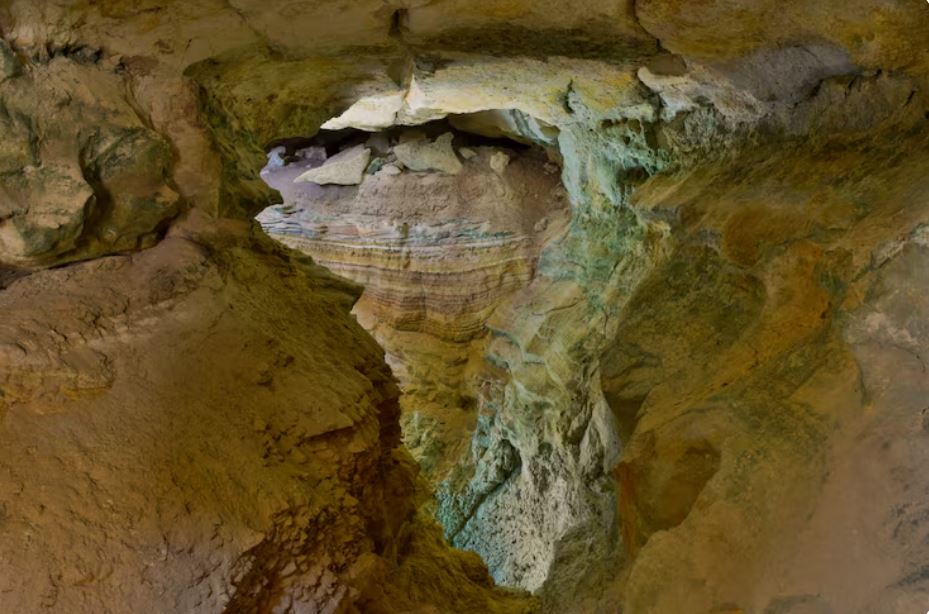
In the solar system, lava tubes are not uncommon. They are widespread on Earth and have been confirmed on the Moon and Mars. Hawaii’s volcanic terrain is full of them, some of which are big enough to fit a bus. The basic process is simple: hot lava flows from a volcano, cools and solidifies on the outside, and eventually stops and drains away, leaving an empty tunnel in its wake.
The scale of the Venus discovery is what makes it intriguing. The tube that Bruzzone’s team discovered is bigger than anything on Earth, bigger than the lava tubes that were anticipated for Mars, and comparable to the biggest known examples on the Moon, which benefited from the Moon’s significantly lower gravity slowing the roofs’ structural collapse. A kilometer-wide tube with a 150-meter roof is even more remarkable structurally because Venus has a higher gravity than the Moon. The main theory is that because of Venus’s dense atmosphere and lower gravity than Earth, lava flows can quickly form thick, insulating crusts that preserve wider channels before cooling.
Only the area close to the skylight can be directly verified using the data at hand, but the analysis indicates that the conduit may run at least 45 kilometers underground. The remaining portion of the estimate is derived from examining the surrounding terrain, including how the ground slopes, whether similar pit chains are present nearby, and whether the surface morphology is consistent with what would be expected above a lengthy underground passage. Although it is a logical conclusion, it is still an inference. Instruments that aren’t currently in Venus orbit will be needed for confirmation.
It is expected to close, perhaps in this decade. Launched in 2031, ESA’s EnVision mission will carry a Subsurface Radar Sounder that is specifically made to reach several hundred meters below Venus’s surface. It can map lava tube networks that have no skylights, no surface collapses, and no discernible signature at all in traditional radar imagery because it can detect underground voids even in the absence of visible surface openings. A similar launch window is the goal of NASA’s VERITAS mission, which will have high-resolution radar that can detect far smaller surface features than Magellan ever could. The possibility of new, high-resolution observations of Venus appears to be generating levels of enthusiasm in planetary scientists who have been working with data that is three decades old that are difficult to fully express in polite scientific language.
The subtle elegance of what transpired here is difficult to ignore. A spacecraft that was purposefully destroyed in September 1994 and finished its mission before the internet became widely used left behind data rich enough to continue making discoveries in 2026. Instead of using fresh observations, the researchers who discovered the lava tube used improved techniques on previously collected data. That’s a specific kind of scientific patience, and it illustrates how much we still don’t know about a planet that, at its closest approach to Earth, is less than 38 million kilometers away and has been visible to naked-eye observers for all of recorded human history. What is beneath Venus’s surface is still a mystery. It’s growing bigger, more bizarre, and more fascinating than the conventional depiction of a geologically dead world ever would have imagined.